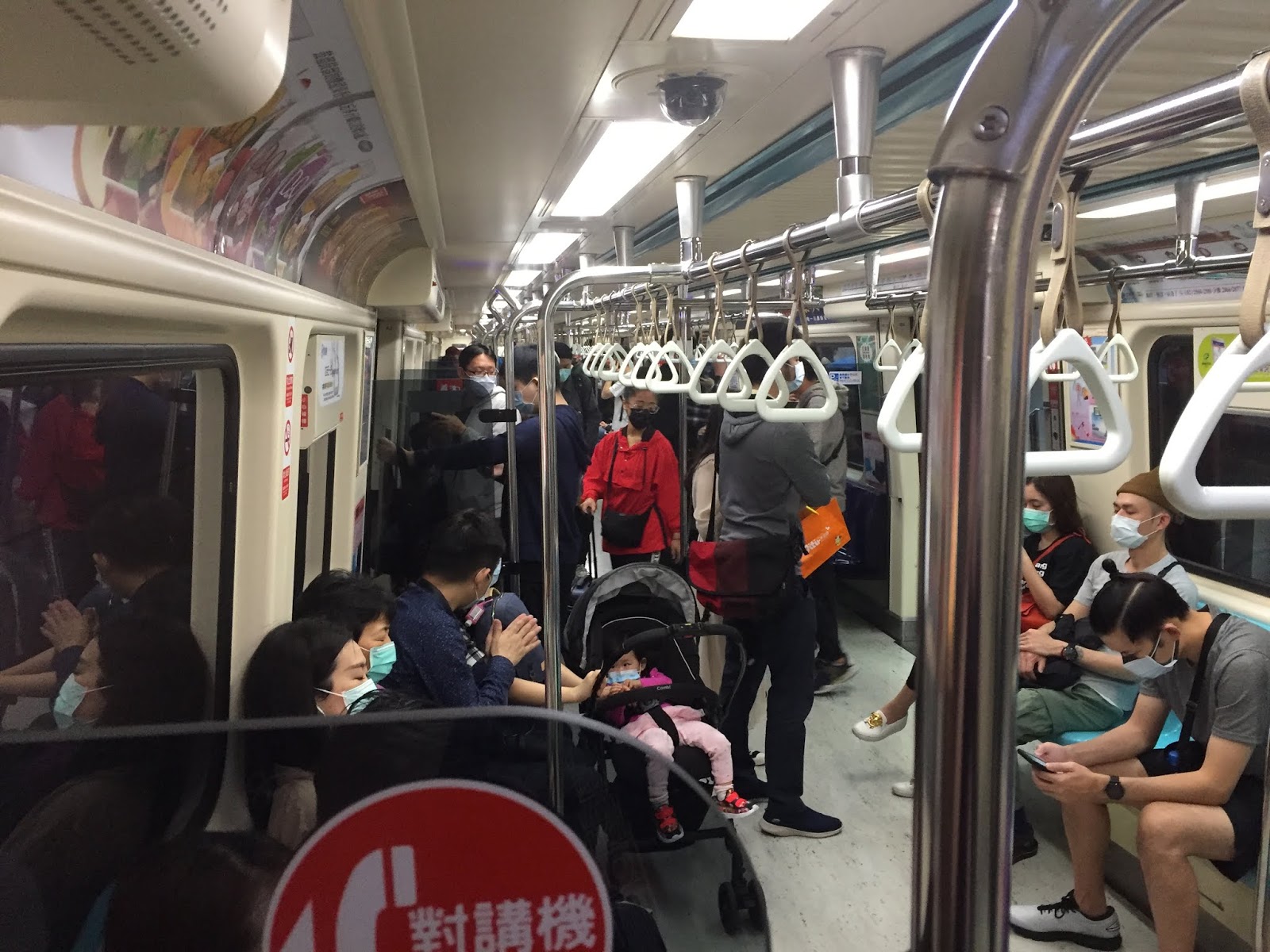
One of the easiest places in Taiwan to get around in the rain is Taipei. Much of it is indoors and the MRT goes everywhere, underground. Taipei is also far more foreigner-friendly than the south. There are “English” signs all over the place and more people speak at least some version of English than anywhere else in the country. Didier wisely chose to go on a day that both Lily and I were available.
Rather than drive, we took the gaotie. The drive from Kaohsiung to Taipei takes at least four hours, under the best conditions. Once there, driving is pointless and parking is expensive. The fastest train takes 90 minutes. Didier's previous train experience was on the xiaotie from Chiayi to Tainan. Otherwise, he got free rides everywhere. For him, the difference between xiaotie and gaotie was like transporting from 1980 to the early 21st century.
One of the Taipei stops is Taipei Main Station, the only gaotie station in a city center. The station directly connects to the two largest MRT lines, the main bus station, and the xiaotie station. It is also an easy walk to several museums, 228 Peace Park, and the Chiang Kai Shek Memorial. Chiang Kai Shek was a murderous dictator, but his memorial hall is one of the more impressive architectural landmarks in the country. Had it not already been on Yi Jun's list, I would have recommended it.
Lily recommended busy and bustling sights like Bopiliao and Ximending, both of which are good examples of Taiwan's culture, though from different centuries. Bopiliao (Longshan Temple station exit #3) is an old Qing Dynasty street that has been restored to its natural state, with seismic reinforcement and ample fire exits. Ximending (Ximen station exit #6) is a purely modern pedestrian street. People often claim it looks like Tokyo, but that is only because there are millions of neon lights and youngsters shopping all night. That is where the similarities end. Both streets are close to Longshan Temple (Longshan Temple station exit #1). At 300 years, it is not the oldest temple in Taiwan, but it is probably the most famous.
That would have been an easy afternoon of walking, but Didier wanted to avoid the crowds, and he had already spent a day at Fo Guang Shan. Longshan Temple and Fo Guang Shan are completely different religions, but from his European point of view, they were the same.
I suggested a few museums. They are indoors and never nearly as crowded as the shopping streets. From Taipei Main Station, the Museum of Contemporary Art is one block north, the National Taiwan Museum (NTU Hospital exit #4) is three blocks south, and the National Museum of History (Xiaonanmen exit #3) is a few blocks further south. The National Taiwan Museum is in 228 Peace Park (NTU Hospital exit #1 & #4), which is a nice little park a block away from the Chiang Kai Shek Memorial Hall (Chiang Kai Shek Memorial Hall exit #5). The National Museum of History is in the Taipei Botanical Garden (Xiaonanmen exit #3), which is a nice little garden just west of Chiang Kai Shek. Walking to any or all of the museums would be easy. Instead, we went to the National Palace Museum in Shilin, which is nowhere near Taipei Main Station. It is, however, the single best place in the world to see Imperial Chinese art. Didier liked the sound of that.
Taipei is known for its nightlife, with the most popular shopping, the most expensive dance clubs, and the most famous night markets in the country. Didier wanted to avoid everything. I find a night of dancing quite relaxing, but he was still afraid of being around too many people while his side of the world was deep into a plague. Even stranger, he was not a fan of dancing. Something he was willing to do was take the turbolift up to the top of Taipei 101 (Taipei 101 exit #4). I think the views are much better in the daytime, if it is not too cloudy, but the lights at night show how large Taipei is, by Taiwan standards, and how tiny it is compared to Tokyo.
We spent the night at the Home Hotel (Taipei 101 exit #4), a small boutique hotel about three blocks from Taipei 101. It was also the hotel I stayed in the first time I went to Taipei. I like it because it is smaller than the typical business hotel and the service is better than anywhere else in the city.
We started the next day with a morning bicycle ride through the riverside parks along the Keelung River. Morning is easily the best time to ride a bicycle in Taipei. Not so much for the weather. It is always going to be hot and humid, no matter what time of day. But afternoons and evenings along the river get far too crowded. Mornings are comparatively empty. There are almost no lights along the winding river, and the packs of stray dogs can get a bit territorial, so the middle of night might not be the best time. There are a variety of hiking options in eastern Taipei, but we did some hiking in Kenting, so Didier was looking for something a little less strenuous.
Had it just been Lily and me, we would have ridden the bicycles from the hotel to the river. It is only a ten minute ride, at most, but it requires navigating busy streets and dodging traffic in a country where right of way is an alien concept. Anyone without a firm understanding of the culture should stick with the clearly marked bicycle paths in areas where cars and trucks are physically blocked from entering. With Didier, we took the MRT to Jiannan (exit #3) and rode through the more scenic parks just north of the airport. Starting from Nangang and riding west until the river ends makes more sense, but Didier is more of a leisurely stroll bicyclist.
The Sun Yat Sen Memorial Hall (Sun Yat Sen Memorial Hall exit #4) was on Didier's list, so we went there. When there are no performances or events, the hall is little more than a large public space. There are better parks in Taipei, but it is an easy walk from Taipei 101. Before we went to Taipei, I thought Taipei Main Station would be our hub from which to branch out around the city. But since we stayed at a hotel next to Taipei 101, that became our reference point.
Just outside the Sun Yat Sen MRT station (exit #2) is a “German” bakery that I thought Didier might enjoy. Like pretty much everything else in Taiwan, it is far more Taiwanese than whatever other region it claims, but they have large German style pretzels. Lily thinks they are terrible, but she is not German. Neither is Didier, but France is a lot closer than Canada. He had been in Taiwan for a while at this point, and I know of no authentic French restaurants anywhere in the country, so a fake German bakery would have to do. Unfortunately, Didier agreed with Lily about the pretzels. But he liked the brioche.
About a ten minute walk north of the bakery is Little New York Pizza. Lily says it is the best pizza in Taiwan. It certainly looks like New York pizza, and the slices are large enough, but I doubt it tastes anything like New York. It was also not at all French, but our goal was to find food unlike the Taiwanese and Chinese Didier had been eating every day. Pizza, at least real pizza with tomato sauce and cheese, is not at all Chinese.
There are thousands of pizza places in Taipei, if not hundreds. Most of them claim to have the best pizza in the city, county or country. It is as absurd as all the “original” pizza places in New York. Unfortunately, I can say nothing about the taste, but few look like they could ever be the best. Far too many serve “pizza” without cheese or sauce, and for some reason, proofing the dough is considered unlucky. Almost all of them serve something other than pizza as a main course. Most have more traditional Chinese dishes. More than a few have various noodle and/or pasta dishes. Little New York is the only one I know about that only has pizza, aside from fries and maybe garlic bread, but those are acceptable side dishes. In my experience, the best pizza places concentrate on pizza. Anything else on the menu is an afterthought. Big Boyz Pizza in Songshan (Nanjing Fuxing exit #5) has Chicago style, which is unheard of in Taiwan, but their New York pizza looks nothing like New York, and Lily said it was criminally undercooked. If they can't take the time to cook a New York pizza, I can only imagine how the Chicago turns out.
I should probably point out that there is more than one Little New York Pizza in Taipei. The one on Yanji Street, just north of Civic Blvd, is the only one that is all pizza. The others have larger restaurant menus.
From Taipei, we went to Hsinchu. The gaotie only takes 30 minutes, but the Hsinchu station is not actually in the city of Hsinchu. Ordinarily, a trip around Taiwan could easily skip Hsinchu, but Didier heard that Hsinchu is the technological capital of Taiwan. While true, that does little for visitors, unless you want to tour a semiconductor factory. Since Lily knows someone who knows someone whose house we could stay in, we went to Zhubei, which is just across the river from Hinschu. Conveniently and coincidentally, the house was only a ten minute Uber ride from the Hsinchu gaotie station, which is in Zhubei.
I downloaded Uber onto my phone for this trip. I had thought about using it once before, but I have a car in Kaohsiung and use the MRT in Taipei. I almost never have any need for Uber, unless I am going to or coming from the airport. Then I get a ride from someone or take a taxi. While Hsinchu has plenty of taxis, I thought we would spend more time going back and forth between Zhubei and Hsinchu. Having Uber on my phone made sense.
Downloading the app was a bit of a chore. My 4-year-old phone has its original battery. I can remember a time when I would charge it two or three times a week. Now, I keep it plugged in when not in use. Downloading the Uber app sucked up the battery. I had to plug mobile devices into other mobile devices, making everything far less mobile. It was a whole production. The app works exactly as it should, and the technology is pretty impressive. I push a button on my phone and in five minutes or less, someone picks me up and takes me where I want to go. And no cash changes hands. But I have to make sure my battery is above 80% when I use it. I was at 70% when I opened the app one time, and 1% when I gave the driver a 5 star review. I might need to get a new battery.
I hate the entire “citizen critic” system that has infected every aspect of modern life. Everyone wants to give everything a review. Almost no one is qualified to be a professional critic in any given field, and most people are not nearly as nice online as they are in person. I say, unless your driver was smoking or drunk, give him 5 stars. Was the ride perfect in every possible way? Probably not. But there is no need to be a dick about it.
We did pretty much nothing in Hsinchu and spent most of our time in Zhubei. The house where we stayed was in the middle of the restaurant district. There were no French restaurants, of course, but they had a branch of a Taiwanese-Italian restaurant we have in Kaohsiung and a popular pizza place that is generally decent, but not New York.
Hsinchu was nothing like Didier expected, but he took the technological label a little too literally. He thought it was going to be some advanced city with evidence of the future in every direction. Instead, he got a typical Taiwan city that looks pretty much like every other Taiwan city. Taiwan has a lot of positive aspects, but it is definitely not known for its architecture. Go to pretty much any city in western Europe and you will see people taking pictures of random buildings. No one does that in Taiwan. I expected nothing out of Hsinchu, but found a nice little neighborhood across the river.
When Didier finally went home, he had only crossed a fraction of the places he wanted to see off his list. It was an unrealistic list. Taiwan is a small country, but you can never see it all in one visit. He is always free to come back, but I get the impression that this place is simply too depressing for him. Not because he and Yi Jun spent too much time here, but because they did not spend nearly enough.
Showing posts with label riding places. Show all posts
Showing posts with label riding places. Show all posts
Wednesday, October 20, 2021

Sunday, March 22, 2020
Taipei Holiday – Trains & Bridges


Near Rainbow Bridge, but facing First MacArthur Bridge.

Chengmei Riverside Park

Every four months, it all gets whitewashed away.


Tuesday, March 10, 2020
Soaking In Su'ao
On 29 February 2020, we went to Su'ao, for a few reasons. Someone told us that it was a quick and painless one hour bus ride from Nangang, the weather was good, and it was one of those situations that come up spontaneously that you either jump at or let pass by and know it will never come up again. Had we not gone to Su'ao on this trip, we would have probably lived the rest of our lives without ever knowing the place exists.
Su'ao is a tiny fishing village on the southern tip of Yilan County, which is to the immediate southeast of Taipei County. The road from Nangang to Yilan is entirely mountains. From the bus, we could easily see over the edge of the road, which was often suspended high enough between hilltops that crashing over would have made the evening news. Fortunately for everyone who drives back and forth between the two, Taiwan spent 15 years and a few billion dollars to dig a few tunnels through the mountains. The final tunnel, when headed south, is the longest tunnel in Taiwan. Apparently, the 30 minute drive from Nangang to Yilan took over two hours before they bore through the mountains.
Once out of the last tunnel, the mountains of Taipei County gave way to the open plains of Yilan County. But we could still see plenty of mountains. Yilan is bordered to the north, west and south by mountains. East of Yilan is the Pacific Ocean. The drive from the northern tip of Yilan to the south is another 30 minutes at practically sea level.
Though Yilan borders the ocean, Su'ao was the only coastal village anyone ever recommended we see. The Taiwanese, much like the Chinese, are not terribly impressed by waterfront property. The few people who live on the coast are usually too poor to afford a nice house deeper inland, where there are more pubs and far less parking. Su'ao was less Côte d'Azur and more Kat O.
Downtown Su'ao looked like downtown any city in Taiwan. I mean no disrespect to the people of Taiwan, but the cities are mostly drab, homogeneous and the opposite of photogenic. It is the natural side of Taiwan that makes the country beautiful.
The fishing village was small enough to walk around in an hour or less, at a leisurely pace. It had the usual temples, snack carts and about a million places to get a drink. One of the great things about Taiwan is that you are never more than a block away from food and drinks.
Just south of the fishing village was an observation platform built on one of the mountains. The climb up was not particularly steep. We saw no one else on the trail, and assumed the platform would be empty. Once there, we saw at least a hundred people on a wooden deck that was probably not built to withstand one hundred people. If the platform ever collapses, everyone on it will plunge straight down to their deaths. How everyone got there was a mystery. The tiny parking lot next to the platform could hold a dozen cars at most, and street parking on the winding road uphill was neither safe nor available.
The view from the observation platform was limited by geography. Directly west and south were hilltops. North was the fishing village, with smaller hills blocking any view farther north. East was a small beach with hard sand the color of concrete. It was a good day to go to the beach, but that beach did not look inviting to us. Beyond the beach was the Pacific Ocean, which always looks good on a clear day, but there were no waves to make it more interesting.
Though we decided not to go to the beach, the trail down from the observation platform led us pretty close, so we had a look. Had I been born and raised in a desert and never traveled, I might think this was a nice beach. As it is, I have been to Bali, Antibes, Hawaii, Florida, California, Tel Aviv and probably a hundred other places with nicer beaches. I assume Taiwan has nicer beaches somewhere. I think this is more of a problem with comparing unequal things than anything wrong with the beach itself. Similarly, people like to tell me about all the temples in Taiwan. But I have seen a million Buddhist, Hindu, Confucian, Taoist, Shinto temples and shrines in China, Thailand and Japan. After a while, they all start to blend together. It would be like taking a tour of Christian churches in the United States. The Basilica of Saint Mary in Minneapolis is nice, but the First Church of Whatnot in Anytown, USA is probably nothing you spend much time photographing.
The two most popular activities in Su'ao are eating and bathing. Neither Lily nor I eat seafood. She is painfully allergic to shellfish. Going to a fishing village might not seem like a good idea, but her issue is nothing like some people with peanuts. She has to eat it to react. The mere sight or smell does not harm her.
Bathing, on the other hand, was something that caught our attention. Su'ao is home to Taiwan's only natural calcium carbon springs. They are supposed to have high sodium ion levels and the highest carbonic ion levels in the country. What that boils down to is that the springs are essentially carbonated water, without any of the sugar and syrups of pop. We were told that the water was perfectly safe to drink, but we were never about to try it. Some people even take the water, add various flavored syrups and sell homemade pop on the street. We did not try that either.
The Su'ao cold springs are not hot springs. They average around 22°C/72°F; far from freezing, but a bit of a shock when you first step in. That turned out to be good news for us. Regardless of the heat and humidity, this was still winter, and the Taiwanese are not about to go to a cold spring in the middle of winter. Like their cousins in China, they dress for the season, not the weather. No matter how hot it is, a cold spring is simply not a winter activity. Ironically, hot springs are popular in winter and summer.
This meant we had the place to ourselves. Since the springs are natural and flow in and around Su'ao, there were a few establishments available. Despite the season, they were all open, which means someone must use them in February. I doubt they stayed open on the off chance that some foreigners would happen to show up. The largest, most expensive and most popular cold spring in the middle of the year looked like some kind of ancient Roman bath. We did not use that one, mostly because it was the most expensive and they seemed pretty strict about their 40 minute time limit. The cheapest spring was little more than a stream next to the train tracks. We did not go there either. We wanted something in between.
We chose a mostly outdoor cold spring uphill but not deep into the mountains. All of the springs are natural, but the Taiwanese are capitalist enough that people learned long ago how to limit access and enclose the waters so others have to pay to get in. It was almost like a community swimming pool, except our surroundings were more natural than concrete and the water was nothing like a chlorinated pool/public toilet.
The most expensive cold spring had private cabins. Despite the time limit, we assumed we would have to use that one. Our hotel did not have a swimming pool, so we did not bring bathing suits to Taiwan. Taipei is not the kind of place you go swimming unless your hotel has a pool. The medium priced cold spring did not have private cabins, but the woman who ran the place told us we could wear whatever we wanted in the water. Since it was not a swimming pool, there were no filters to worry about clogging. She told us that most people wore shorts and t-shirts.
I am a firm proponent of swimming nude. But this was not swimming. At no point was the water deep enough to do more than soak. Lily was open to soaking nude. The only other person on the premises was the woman who operated the place. She was a small Chinese woman, somewhere on the border between middle age and elderly. She did not strike us as much of a threat to our safety.
We both wore shorts to Su'ao because it was a hot day and we knew there would be a lot of walking around and hiking. We had t-shirts in our backpacks because bringing extra clothes is always a good idea on any day trip in Taiwan or China. Changing out of our tops and into the t-shirts was an obvious decision. We had no bathing suits, but we had the cold spring uniform.
Lily was quick to point out that wet shorts never feel good while swimming, even if we were only soaking, and feel even worse after you get out of the water and walk around town. We both knew that the heat and oppressive humidity of Taiwan would dry our shorts in no time. We also knew how terrible it would feel between wet and dry. Livia's solution was to not wear shorts. She was willing to soak nude, so soaking in her underwear was not difficult. I wanted more protection. Not so much from prying eyes. There was no one else there. But I knew nothing about that water. Livia reminded me that it was potable. I told her that if she drank some, I would consider soaking nude. I would never walk down the street in what I wore in that cold spring, but no one got naked that afternoon.
Su'ao is a tiny fishing village on the southern tip of Yilan County, which is to the immediate southeast of Taipei County. The road from Nangang to Yilan is entirely mountains. From the bus, we could easily see over the edge of the road, which was often suspended high enough between hilltops that crashing over would have made the evening news. Fortunately for everyone who drives back and forth between the two, Taiwan spent 15 years and a few billion dollars to dig a few tunnels through the mountains. The final tunnel, when headed south, is the longest tunnel in Taiwan. Apparently, the 30 minute drive from Nangang to Yilan took over two hours before they bore through the mountains.
Once out of the last tunnel, the mountains of Taipei County gave way to the open plains of Yilan County. But we could still see plenty of mountains. Yilan is bordered to the north, west and south by mountains. East of Yilan is the Pacific Ocean. The drive from the northern tip of Yilan to the south is another 30 minutes at practically sea level.
Though Yilan borders the ocean, Su'ao was the only coastal village anyone ever recommended we see. The Taiwanese, much like the Chinese, are not terribly impressed by waterfront property. The few people who live on the coast are usually too poor to afford a nice house deeper inland, where there are more pubs and far less parking. Su'ao was less Côte d'Azur and more Kat O.
Downtown Su'ao looked like downtown any city in Taiwan. I mean no disrespect to the people of Taiwan, but the cities are mostly drab, homogeneous and the opposite of photogenic. It is the natural side of Taiwan that makes the country beautiful.
The fishing village was small enough to walk around in an hour or less, at a leisurely pace. It had the usual temples, snack carts and about a million places to get a drink. One of the great things about Taiwan is that you are never more than a block away from food and drinks.
Just south of the fishing village was an observation platform built on one of the mountains. The climb up was not particularly steep. We saw no one else on the trail, and assumed the platform would be empty. Once there, we saw at least a hundred people on a wooden deck that was probably not built to withstand one hundred people. If the platform ever collapses, everyone on it will plunge straight down to their deaths. How everyone got there was a mystery. The tiny parking lot next to the platform could hold a dozen cars at most, and street parking on the winding road uphill was neither safe nor available.
The view from the observation platform was limited by geography. Directly west and south were hilltops. North was the fishing village, with smaller hills blocking any view farther north. East was a small beach with hard sand the color of concrete. It was a good day to go to the beach, but that beach did not look inviting to us. Beyond the beach was the Pacific Ocean, which always looks good on a clear day, but there were no waves to make it more interesting.
Though we decided not to go to the beach, the trail down from the observation platform led us pretty close, so we had a look. Had I been born and raised in a desert and never traveled, I might think this was a nice beach. As it is, I have been to Bali, Antibes, Hawaii, Florida, California, Tel Aviv and probably a hundred other places with nicer beaches. I assume Taiwan has nicer beaches somewhere. I think this is more of a problem with comparing unequal things than anything wrong with the beach itself. Similarly, people like to tell me about all the temples in Taiwan. But I have seen a million Buddhist, Hindu, Confucian, Taoist, Shinto temples and shrines in China, Thailand and Japan. After a while, they all start to blend together. It would be like taking a tour of Christian churches in the United States. The Basilica of Saint Mary in Minneapolis is nice, but the First Church of Whatnot in Anytown, USA is probably nothing you spend much time photographing.
The two most popular activities in Su'ao are eating and bathing. Neither Lily nor I eat seafood. She is painfully allergic to shellfish. Going to a fishing village might not seem like a good idea, but her issue is nothing like some people with peanuts. She has to eat it to react. The mere sight or smell does not harm her.
Bathing, on the other hand, was something that caught our attention. Su'ao is home to Taiwan's only natural calcium carbon springs. They are supposed to have high sodium ion levels and the highest carbonic ion levels in the country. What that boils down to is that the springs are essentially carbonated water, without any of the sugar and syrups of pop. We were told that the water was perfectly safe to drink, but we were never about to try it. Some people even take the water, add various flavored syrups and sell homemade pop on the street. We did not try that either.
The Su'ao cold springs are not hot springs. They average around 22°C/72°F; far from freezing, but a bit of a shock when you first step in. That turned out to be good news for us. Regardless of the heat and humidity, this was still winter, and the Taiwanese are not about to go to a cold spring in the middle of winter. Like their cousins in China, they dress for the season, not the weather. No matter how hot it is, a cold spring is simply not a winter activity. Ironically, hot springs are popular in winter and summer.
This meant we had the place to ourselves. Since the springs are natural and flow in and around Su'ao, there were a few establishments available. Despite the season, they were all open, which means someone must use them in February. I doubt they stayed open on the off chance that some foreigners would happen to show up. The largest, most expensive and most popular cold spring in the middle of the year looked like some kind of ancient Roman bath. We did not use that one, mostly because it was the most expensive and they seemed pretty strict about their 40 minute time limit. The cheapest spring was little more than a stream next to the train tracks. We did not go there either. We wanted something in between.
We chose a mostly outdoor cold spring uphill but not deep into the mountains. All of the springs are natural, but the Taiwanese are capitalist enough that people learned long ago how to limit access and enclose the waters so others have to pay to get in. It was almost like a community swimming pool, except our surroundings were more natural than concrete and the water was nothing like a chlorinated pool/public toilet.
The most expensive cold spring had private cabins. Despite the time limit, we assumed we would have to use that one. Our hotel did not have a swimming pool, so we did not bring bathing suits to Taiwan. Taipei is not the kind of place you go swimming unless your hotel has a pool. The medium priced cold spring did not have private cabins, but the woman who ran the place told us we could wear whatever we wanted in the water. Since it was not a swimming pool, there were no filters to worry about clogging. She told us that most people wore shorts and t-shirts.
I am a firm proponent of swimming nude. But this was not swimming. At no point was the water deep enough to do more than soak. Lily was open to soaking nude. The only other person on the premises was the woman who operated the place. She was a small Chinese woman, somewhere on the border between middle age and elderly. She did not strike us as much of a threat to our safety.
We both wore shorts to Su'ao because it was a hot day and we knew there would be a lot of walking around and hiking. We had t-shirts in our backpacks because bringing extra clothes is always a good idea on any day trip in Taiwan or China. Changing out of our tops and into the t-shirts was an obvious decision. We had no bathing suits, but we had the cold spring uniform.
Lily was quick to point out that wet shorts never feel good while swimming, even if we were only soaking, and feel even worse after you get out of the water and walk around town. We both knew that the heat and oppressive humidity of Taiwan would dry our shorts in no time. We also knew how terrible it would feel between wet and dry. Livia's solution was to not wear shorts. She was willing to soak nude, so soaking in her underwear was not difficult. I wanted more protection. Not so much from prying eyes. There was no one else there. But I knew nothing about that water. Livia reminded me that it was potable. I told her that if she drank some, I would consider soaking nude. I would never walk down the street in what I wore in that cold spring, but no one got naked that afternoon.
Wednesday, March 4, 2020
Peddling Down the Keelung
On 28 February 2020, I went to Taipei with my sister, Lily. We had both been to Taipei, but never on a holiday. February 28 is a public holiday in Taiwan, commemorating the 228 massacre. As such, we went to the 228 Peace Memorial Park, a block from the Chiang Kai Shek Memorial Hall. We had been there before, but never on 2/28. If you want to go to 228 Peace Park, that is really the day to go. It was something different.
More often than not, the park is a quiet little place to get away from the traffic of Taipei. It is small, so you can hear the city wherever you are in the park, but there are no cars or scooters allowed inside. That makes it much safer. On 2/28, it gets busy.
The current president of Taiwan, Tsai Ing Wen, gave a speech. I don't know anything about her or her policies, but I like how she broke a lot of the rules. Not only does she not have a penis, she does not have a husband, did not climb up the traditional ladder of political power, and she is the only president of Taiwan to have any native Taiwanese ancestry. She was elected with 56% of the votes in a three way race. That's pretty good. The KMT candidate came in second with 31%. Also, she was named after the English language. That beats the previous president, whose name literally translates to Nine English Horses. More importantly, Tsai has always been an outspoken critic of the government handling of the 228 aftermath. Previous presidents mostly said, “It was a terrible tragedy, but what can you do?” If you are going to watch any Taiwan president give a 228 speech, Tsai is the one.
Lily and I have been to Taipei a few times. I always tell people who go to Tokyo that they should concentrate on one neighborhood on each visit and go to a different neighborhood on the next visit, since the city is so large. I rarely take my own advice, however, and usually stay in Shibuya whenever I go. For Taipei, a much smaller city than Tokyo, I do it the Tokyo way. We and/or I have stayed in Xinyi, Zhongzheng, Da'an, Zhongshan and now Nangang.
Xinyi is just east of downtown, with most of the important commercial buildings. Zhongzheng is downtown, with most of the important government buildings. Da'an is downtown, with most of the educational institutions and more than a few night markets. Zhongshan is downtown, with most of the important brothels.
Nangang is nowhere near downtown and as far east as you can go without leaving Taipei. You have to climb mountains to get any farther east. Its claim to fame seems to be a large convention and exhibition center. What I liked about Nangang was all the transportation. The high speed train station, slow speed train station, MRT station and bus station are all in one large complex. Just outside the station were an endless line of taxis and a row of Youbikes. Lily and I both have MRT cards from a previous trip, with which we could rent bikes, ride trains and buses, and generally use like an Octopus.
We stayed at the Place Taipei, which was an unusually clean hotel. Probably because it opened in March 2019. It was yet another typical business hotel, something Taipei has in abundance, but the location was excellent. The Nangang super station was an easy 15 minute walk away, the Nangang Exhibition Center MRT station was five minutes away and the Nangang Software Park MRT station was across the street from the hotel. Most hotels in Taipei are surrounded by food, but this one was in a newer neighborhood, so most of the food was more upscale. Fortunately, this was Taiwan. Finding cheaper everyday food is always easy.
There were Youbike stations at Nangang Software Park, Nangang MRT and the shopping mall just south of the hotel. It was an easy neighborhood to walk around, but not particularly safe for bicyclists. We were never going to ride around the streets anyway. Two blocks from the hotel was the Keelung River, which has miles and miles of riverside parks with walking and bicycle paths.
From the Nanhu Bridge, we rode west along the north bank of the river. We passed a dozen playgrounds and athletic fields before we reached Zhongshan. We immediately recognized the Marriott, where we stayed on our last trip to Taipei. As the tallest building on the horizon, it was hard to miss. The last time we rode bikes east of that hotel, we had to turn around when the river paths ended somewhere in Neihu. Between then and now, they have extended the paths to at least Nangang. We did not even realize we were at the same place until we hit the Zhongshan path.
Now that we knew where we were, we knew that the bike path would continue into Shilin, so we kept riding west. The Zhongshan stretch of the river was easily the busiest part. There were more playgrounds, basketball courts, tennis courts, baseball diamonds and picnic grounds than at any other stretch of the river. More importantly, there were parking lots. I have no idea where anyone parks at other points along the river. Probably somewhere that cannot be seen from the river. But just south of the Marriott, they can park all along Meiti Park. Ample parking and the fact that this was the Sunday of a three day weekend meant this section of the river was far more crowded than any other. We could race at our top speeds in Nangang and Neihu, if we were so inclined. In Zhongshan, we had to slow down considerably for foot traffic, and often stop.
Past the tennis courts, the crowds disappeared. Possibly because there was no more parking that far west. More likely because the level road quickly became hilly. The downhill part was pretty easy. Uphill required more effort on a bicycle. Hitting the hill at speed was pretty much impossible because there was a sharp turn in the path just before the hill. You have no choice but to attack the hill almost at a standing stop. Beyond all that, it leveled off again as the river runs north. The change in direction also brought an added bonus of a nice breeze, at least both of the times I have ridden a bicycle along this river. Trees also provided the only shade along the paths, other than a few bridges passing overhead. This was Taipei, so it was never cold, but this was easily the coldest stretch along the riverside parks.
The paths continued, but the parks ended at a smaller parking lot and tiny basketball court. Beyond the last parking lot, the parks started up again. They were smaller than the Zhongshan parks, but looked pretty much the same. As the Keelung River continues north, a tributary and the bike paths veer east. The parks pretty much ended for good at some kind of dyke/water pumping station. It was not all that scenic, but the paths continued, and so did we. The tributary was smaller than the river, as tributaries usually are, and the area became more industrial than green. We took that as our sign to turn around and head back. It looked like the bicycle path was going to end in about a kilometer anyway.
Before going back, we were headed east, but there was no way that path was going to get us back to Nangang. Not only does the river not flow in a circle, but there are mountains between Shilin and Nangang. The easiest ways to get back were either to return the bikes at the nearest Youbike station and take the MRT red line to the blue line to Nangang, or simply ride back whence we came. We had plenty of time, plenty of water and the weather was on our side.
According to Hong Kong Google, Taipei was going to rain all weekend. Friday started out cloudy, but quickly shifted to sunny and hot. Without a hat, I would have gotten sunburned. Saturday was pretty much the same as Friday morning. It was not until late Sunday afternoon that the clouds started to get gloomy. We headed to the airport before 17:00, so whether it was going to rain that night or not, it had nothing to do with us.
More often than not, the park is a quiet little place to get away from the traffic of Taipei. It is small, so you can hear the city wherever you are in the park, but there are no cars or scooters allowed inside. That makes it much safer. On 2/28, it gets busy.
The current president of Taiwan, Tsai Ing Wen, gave a speech. I don't know anything about her or her policies, but I like how she broke a lot of the rules. Not only does she not have a penis, she does not have a husband, did not climb up the traditional ladder of political power, and she is the only president of Taiwan to have any native Taiwanese ancestry. She was elected with 56% of the votes in a three way race. That's pretty good. The KMT candidate came in second with 31%. Also, she was named after the English language. That beats the previous president, whose name literally translates to Nine English Horses. More importantly, Tsai has always been an outspoken critic of the government handling of the 228 aftermath. Previous presidents mostly said, “It was a terrible tragedy, but what can you do?” If you are going to watch any Taiwan president give a 228 speech, Tsai is the one.
Lily and I have been to Taipei a few times. I always tell people who go to Tokyo that they should concentrate on one neighborhood on each visit and go to a different neighborhood on the next visit, since the city is so large. I rarely take my own advice, however, and usually stay in Shibuya whenever I go. For Taipei, a much smaller city than Tokyo, I do it the Tokyo way. We and/or I have stayed in Xinyi, Zhongzheng, Da'an, Zhongshan and now Nangang.
Xinyi is just east of downtown, with most of the important commercial buildings. Zhongzheng is downtown, with most of the important government buildings. Da'an is downtown, with most of the educational institutions and more than a few night markets. Zhongshan is downtown, with most of the important brothels.
Nangang is nowhere near downtown and as far east as you can go without leaving Taipei. You have to climb mountains to get any farther east. Its claim to fame seems to be a large convention and exhibition center. What I liked about Nangang was all the transportation. The high speed train station, slow speed train station, MRT station and bus station are all in one large complex. Just outside the station were an endless line of taxis and a row of Youbikes. Lily and I both have MRT cards from a previous trip, with which we could rent bikes, ride trains and buses, and generally use like an Octopus.
We stayed at the Place Taipei, which was an unusually clean hotel. Probably because it opened in March 2019. It was yet another typical business hotel, something Taipei has in abundance, but the location was excellent. The Nangang super station was an easy 15 minute walk away, the Nangang Exhibition Center MRT station was five minutes away and the Nangang Software Park MRT station was across the street from the hotel. Most hotels in Taipei are surrounded by food, but this one was in a newer neighborhood, so most of the food was more upscale. Fortunately, this was Taiwan. Finding cheaper everyday food is always easy.
There were Youbike stations at Nangang Software Park, Nangang MRT and the shopping mall just south of the hotel. It was an easy neighborhood to walk around, but not particularly safe for bicyclists. We were never going to ride around the streets anyway. Two blocks from the hotel was the Keelung River, which has miles and miles of riverside parks with walking and bicycle paths.
From the Nanhu Bridge, we rode west along the north bank of the river. We passed a dozen playgrounds and athletic fields before we reached Zhongshan. We immediately recognized the Marriott, where we stayed on our last trip to Taipei. As the tallest building on the horizon, it was hard to miss. The last time we rode bikes east of that hotel, we had to turn around when the river paths ended somewhere in Neihu. Between then and now, they have extended the paths to at least Nangang. We did not even realize we were at the same place until we hit the Zhongshan path.
Now that we knew where we were, we knew that the bike path would continue into Shilin, so we kept riding west. The Zhongshan stretch of the river was easily the busiest part. There were more playgrounds, basketball courts, tennis courts, baseball diamonds and picnic grounds than at any other stretch of the river. More importantly, there were parking lots. I have no idea where anyone parks at other points along the river. Probably somewhere that cannot be seen from the river. But just south of the Marriott, they can park all along Meiti Park. Ample parking and the fact that this was the Sunday of a three day weekend meant this section of the river was far more crowded than any other. We could race at our top speeds in Nangang and Neihu, if we were so inclined. In Zhongshan, we had to slow down considerably for foot traffic, and often stop.
Past the tennis courts, the crowds disappeared. Possibly because there was no more parking that far west. More likely because the level road quickly became hilly. The downhill part was pretty easy. Uphill required more effort on a bicycle. Hitting the hill at speed was pretty much impossible because there was a sharp turn in the path just before the hill. You have no choice but to attack the hill almost at a standing stop. Beyond all that, it leveled off again as the river runs north. The change in direction also brought an added bonus of a nice breeze, at least both of the times I have ridden a bicycle along this river. Trees also provided the only shade along the paths, other than a few bridges passing overhead. This was Taipei, so it was never cold, but this was easily the coldest stretch along the riverside parks.
The paths continued, but the parks ended at a smaller parking lot and tiny basketball court. Beyond the last parking lot, the parks started up again. They were smaller than the Zhongshan parks, but looked pretty much the same. As the Keelung River continues north, a tributary and the bike paths veer east. The parks pretty much ended for good at some kind of dyke/water pumping station. It was not all that scenic, but the paths continued, and so did we. The tributary was smaller than the river, as tributaries usually are, and the area became more industrial than green. We took that as our sign to turn around and head back. It looked like the bicycle path was going to end in about a kilometer anyway.
Before going back, we were headed east, but there was no way that path was going to get us back to Nangang. Not only does the river not flow in a circle, but there are mountains between Shilin and Nangang. The easiest ways to get back were either to return the bikes at the nearest Youbike station and take the MRT red line to the blue line to Nangang, or simply ride back whence we came. We had plenty of time, plenty of water and the weather was on our side.
According to Hong Kong Google, Taipei was going to rain all weekend. Friday started out cloudy, but quickly shifted to sunny and hot. Without a hat, I would have gotten sunburned. Saturday was pretty much the same as Friday morning. It was not until late Sunday afternoon that the clouds started to get gloomy. We headed to the airport before 17:00, so whether it was going to rain that night or not, it had nothing to do with us.
Monday, December 24, 2018
Island Hopping part 2
About two miles southeast of Kau Sai Chau is a cluster of four islands. Fo Tau Fan Chau houses a drug rehab hospital. We saw no reason to go there. Wang Chau is a rocky brown island with some green patches on top. It has a few sea caves and some more of those rocks that rock people love to look at. The southern coast has jagged cliffs that look like they are going to collapse at any minute, but have probably been around for a million years. Fo Sek Chau has more of the same, on a larger scale. Probably because it is three times larger than Wang Chau. Sha Tong Hau Shan is roughly the same size as Fo Sek Chau, but taller. The jagged cliffs are taller and some of the sea caves are big enough to ride through in a kayak or small row boat. Even better, there is some coral around the island. It is dying and will probably be gone pretty soon, but we came prepared with snorkels.
We spent more time at Fo Sek Chau than any of the others. Sha Tong Hau Shan has the coral, which is nice to look at, but Fo Sek Chau has better coves and caves to swim around. There are more than enough large boulders sticking out of the water to use as diving boards and the water is clear enough to see all the jagged rocks hiding underneath the surface. The current is not especially strong around the island, so swimming through the sea caves is not at all dangerous. Even if a current did pull you away, it would simply take you in one mouth of a cave and spit you out another.
I love swimming and have been doing it all of my life. It is great exercise, of course, but I think I mostly like all the floating and freedom of movement. I have always loved the way water feels, but it took me a long time to realize that swimming naked is a million times better than swimming with a bathing suit. Wet clothes never feel right, while wet skin is natural.
Unfortunately, Hong Kong has laws against that sort of thing. There are a few nude beaches, but they are technically illegal. And we were nowhere near any of the unofficial nude beaches. I might have risked it anyway, but I was with Hisoka. Seeing each other naked on our third date was not the issue. Due to circumstances beyond my control, we saw each other naked on our first date. You can probably swim around the islands without any law enforcement ever seeing you. We saw almost no one patrolling the waters the entire time we were bouncing around from island to island. If caught swimming nude, I might have been given a small fine, at most. But Hisoka is a visitor. His visa could be affected, and losing it could threaten his job. His bosses might not care about swimming nude, but they would care about losing face because of some recklessly illegal activity.
So I had to swim with a bathing suit. It was not ideal, but it was far better than nothing. I avoid public swimming pools in Hong Kong for reasons too graphic to get into, and outside of the big house at Clear Water Bay, there are too few options around here. Seven million people live in Hong Kong, a city of islands and peninsulas, yet most of us rarely go into the water. Even at beaches, people are more likely to stay on land. Swimming around Fo Sek Chau is something everyone should do, assuming they know how to swim. There is a gentle peace you get from floating on your back in an enormous body of water away from the traffic and construction of civilization. In the city, you hear noises all the time. It is a constant chorus of machinery and humanity pushing forward. Floating in the ocean, you hear the gentle brush of water flowing against your body. People pay big money to get that kind of serenity. Nature gives it to us for free.
Where I come from, we don't do a lot of swimming in December. But this is Hong Kong. The water around Fo Sek Chau was not tropical summer warm, but it was warm enough. For whatever reason, the water is much cleaner in winter than in summer. It was clear and looked clean enough to drink around Fo Sek Chau and Sha Tong Hau Shan, if it were not salt water. I don't know why the water gets cleaner in winter, but I assume less traffic and less rain has something to do with it. There are more people in the summer, and summer rain drains the city pollution out to sea.
We spent the night at Tai Long Bay. There are a few small islands in the bay, but we never bothered going to any of them. Once the sun goes down, there is no point anyway. Dinner was on the boat. Tai Long Bay is not the best place for restaurants and we had a stocked kitchen with us. More often than not, when I am with people and we are having a home cooked meal, or boat cooked meal, I am doing the cooking. This time, Hisoka wanted to do the cooking. That was fine with me. I don't need a giant executive kitchen, but the combination of tiny and rocking on the water made the boat's kitchen less appealing. Hisoka knew that I would not be able to taste anything, so he had nothing to lose.
After dinner, we sat out on the back deck and watched the stars. In Hong Kong, you almost never see any stars. Kowloon and Hong Kong Island are giant balls of light at night. Tai Long Bay sits between one of the largest country parks and the South China Sea. There is still plenty of light bleeding over from the city, but it is far darker than Nathan Road. I want to say we got naked and took a romantic swim in the bay, but that was never going to happen. Swimming at night is never recommended. If a current drags you away, no one will ever see it. There was light from the boat, but if you face east, which is where the water would take you, it is nothing but black.
The boat had two bedrooms, so spending the night was never going to be awkward. One was slightly larger than the other. Hisoka let me take the larger bedroom because he is a gentleman. Realistically, it never really mattered. The larger room was maybe a few square feet bigger. The most noticeable difference was that it had more windows and they all faced the bow. Had the boat been moving, that would have been the better room. While sleeping, it was all the same.
I briefly thought about inviting Hisoka to my room, or even going to his smaller room. We have known each other for months, but this was only our third date. We have seen each other naked, and we seem to get wet on practically every date, but a third date is just too soon for me. I know about him, but I don't truly know him yet. On one hand, it is a shame. We were so secluded from civilization that we could have done unmentionable things on the deck under the stars and no one but the NSA satellites would have seen us. On the other hand, I simply don't roll that way. I am more vanilla than Izzy's.
The next day, I went for a morning swim in the bay. Hisoka had breakfast ready by the time I was finished with the tiny shower. Imagine trying to take a shower on a plane. Some of the more expensive airlines actually have showers in first class, but the boat's shower was economy size. If Hisoka was hoping to get some morning action, that shower would be the last place two people could fit.
I have had fewer boyfriends than everyone I know. Hisoka is not my boyfriend, obviously. This was only our third date. But if he were, he would be the only one who is as much of a morning person as I am. I generally wake up before dawn. Some of my previous boyfriends had a hard time getting up before noon. Eating breakfast together on a date is a new experience for me. Eating on the deck of a boat in the morning air of the bay is something entirely different. I would love to do it more often, but then it would not be as special.
After breakfast, we headed to Mirs Bay, which is just around the corner from Tai Long Bay. They are close, but nothing alike. Tai Long Bay is maybe two miles across and no more than three miles from beach to ocean. Mirs Bay is larger than Hong Kong Island, Kowloon and Lantau combined. It has some of the deepest water in the city and almost all of the scuba diving sites. The bay houses three different marine reserves and a fair amount of sharks from time to time. It is also the eastern border between Hong Kong and Mainland China.
Our first stop in Mirs Bay was Tap Mun, one of the more developed islands on our journey. The local fishing village only has about 100 people, but the island is a popular camping spot with daily ferries from a few different locations. There are paved hiking trails and park benches that face the rocky beaches. Tap Mun has a few small temples dedicated to sea gods. There is even a public basketball court in the middle of the village.
From Tap Mun, we sailed north to Yan Chau Tong, a small harbor just east of Plover Cove. Yan Chau Tong is entirely too close to Mainland China, but mostly in a protected marine park. We sailed around Wong Wan Chau and Ngo Mei Chau before stopping at Kat O. Kat O has one of the larger fishing villages of the smaller islands and a few small temples, but is mostly protected wilderness. It is also one of the largest islands we saw. Though no more than a few hundred feet wide at any given point, it is three miles long. Kat O has one of the longest coastlines with both rocky and sandy beaches, but nothing as beautiful as Kiu Tsui Chau.
On the opposite side of the bay is Tung Ping Chau, the farthest you can go east and still be in Hong Kong. The island is technically inhabited, but we saw absolutely no one there. The tiny village looked and felt abandoned. Someone is clearly maintaining the small temples on the island, but definitely not full time. Tung Ping Chau is another paradise for rock climbers, with jagged cliffs carved by the sea. Most of the islands in Hong Kong were formed by volcanoes, but Tung Ping Chau is one of the rare sedimentary islands. Best of all, only a few ferries go to the island and only on the weekends. Tung Ping Chau is popular with divers because of the coral and deep waters, but is deserted during the week. We had the place to ourselves.
I don't know if we spent more time on the boat or on the various islands. Getting from one island to the next did not take that long, but we also sailed around smaller islands and rarely went from A to B in a straight line. When I took the steering wheel in Mirs Bay, it was anything but a straight line. While I appreciate how fast some boats can go, I would still rather drive fast in a car. Boats just don't feel right to me. I think the best thing about taking a boat around Hong Kong versus a car is that you have a kitchen and bathroom with you at all times. Finding food while driving around is easy, but public restrooms can be challenging. Especially if you like cleanliness. The view is also a lot better from a boat. There are a few great scenic driving spots in Hong Kong, but the city is mostly traffic and red lights.
As for Hisoka, we both assume there will be a fourth date. No one knows when or where that will be. He goes back and forth from Japan to China all the time and I just started a new job in Amsterdam. The great thing is that neither of us are pushing the other for more information. Whatever happens, it will happen whenever everything works out however it should. The complete absence of pressure and stress is refreshing. Almost like lying on the deck of a boat and watching the stars.

We spent more time at Fo Sek Chau than any of the others. Sha Tong Hau Shan has the coral, which is nice to look at, but Fo Sek Chau has better coves and caves to swim around. There are more than enough large boulders sticking out of the water to use as diving boards and the water is clear enough to see all the jagged rocks hiding underneath the surface. The current is not especially strong around the island, so swimming through the sea caves is not at all dangerous. Even if a current did pull you away, it would simply take you in one mouth of a cave and spit you out another.
I love swimming and have been doing it all of my life. It is great exercise, of course, but I think I mostly like all the floating and freedom of movement. I have always loved the way water feels, but it took me a long time to realize that swimming naked is a million times better than swimming with a bathing suit. Wet clothes never feel right, while wet skin is natural.
Unfortunately, Hong Kong has laws against that sort of thing. There are a few nude beaches, but they are technically illegal. And we were nowhere near any of the unofficial nude beaches. I might have risked it anyway, but I was with Hisoka. Seeing each other naked on our third date was not the issue. Due to circumstances beyond my control, we saw each other naked on our first date. You can probably swim around the islands without any law enforcement ever seeing you. We saw almost no one patrolling the waters the entire time we were bouncing around from island to island. If caught swimming nude, I might have been given a small fine, at most. But Hisoka is a visitor. His visa could be affected, and losing it could threaten his job. His bosses might not care about swimming nude, but they would care about losing face because of some recklessly illegal activity.
So I had to swim with a bathing suit. It was not ideal, but it was far better than nothing. I avoid public swimming pools in Hong Kong for reasons too graphic to get into, and outside of the big house at Clear Water Bay, there are too few options around here. Seven million people live in Hong Kong, a city of islands and peninsulas, yet most of us rarely go into the water. Even at beaches, people are more likely to stay on land. Swimming around Fo Sek Chau is something everyone should do, assuming they know how to swim. There is a gentle peace you get from floating on your back in an enormous body of water away from the traffic and construction of civilization. In the city, you hear noises all the time. It is a constant chorus of machinery and humanity pushing forward. Floating in the ocean, you hear the gentle brush of water flowing against your body. People pay big money to get that kind of serenity. Nature gives it to us for free.
Where I come from, we don't do a lot of swimming in December. But this is Hong Kong. The water around Fo Sek Chau was not tropical summer warm, but it was warm enough. For whatever reason, the water is much cleaner in winter than in summer. It was clear and looked clean enough to drink around Fo Sek Chau and Sha Tong Hau Shan, if it were not salt water. I don't know why the water gets cleaner in winter, but I assume less traffic and less rain has something to do with it. There are more people in the summer, and summer rain drains the city pollution out to sea.
We spent the night at Tai Long Bay. There are a few small islands in the bay, but we never bothered going to any of them. Once the sun goes down, there is no point anyway. Dinner was on the boat. Tai Long Bay is not the best place for restaurants and we had a stocked kitchen with us. More often than not, when I am with people and we are having a home cooked meal, or boat cooked meal, I am doing the cooking. This time, Hisoka wanted to do the cooking. That was fine with me. I don't need a giant executive kitchen, but the combination of tiny and rocking on the water made the boat's kitchen less appealing. Hisoka knew that I would not be able to taste anything, so he had nothing to lose.
After dinner, we sat out on the back deck and watched the stars. In Hong Kong, you almost never see any stars. Kowloon and Hong Kong Island are giant balls of light at night. Tai Long Bay sits between one of the largest country parks and the South China Sea. There is still plenty of light bleeding over from the city, but it is far darker than Nathan Road. I want to say we got naked and took a romantic swim in the bay, but that was never going to happen. Swimming at night is never recommended. If a current drags you away, no one will ever see it. There was light from the boat, but if you face east, which is where the water would take you, it is nothing but black.
The boat had two bedrooms, so spending the night was never going to be awkward. One was slightly larger than the other. Hisoka let me take the larger bedroom because he is a gentleman. Realistically, it never really mattered. The larger room was maybe a few square feet bigger. The most noticeable difference was that it had more windows and they all faced the bow. Had the boat been moving, that would have been the better room. While sleeping, it was all the same.
I briefly thought about inviting Hisoka to my room, or even going to his smaller room. We have known each other for months, but this was only our third date. We have seen each other naked, and we seem to get wet on practically every date, but a third date is just too soon for me. I know about him, but I don't truly know him yet. On one hand, it is a shame. We were so secluded from civilization that we could have done unmentionable things on the deck under the stars and no one but the NSA satellites would have seen us. On the other hand, I simply don't roll that way. I am more vanilla than Izzy's.
The next day, I went for a morning swim in the bay. Hisoka had breakfast ready by the time I was finished with the tiny shower. Imagine trying to take a shower on a plane. Some of the more expensive airlines actually have showers in first class, but the boat's shower was economy size. If Hisoka was hoping to get some morning action, that shower would be the last place two people could fit.
I have had fewer boyfriends than everyone I know. Hisoka is not my boyfriend, obviously. This was only our third date. But if he were, he would be the only one who is as much of a morning person as I am. I generally wake up before dawn. Some of my previous boyfriends had a hard time getting up before noon. Eating breakfast together on a date is a new experience for me. Eating on the deck of a boat in the morning air of the bay is something entirely different. I would love to do it more often, but then it would not be as special.
After breakfast, we headed to Mirs Bay, which is just around the corner from Tai Long Bay. They are close, but nothing alike. Tai Long Bay is maybe two miles across and no more than three miles from beach to ocean. Mirs Bay is larger than Hong Kong Island, Kowloon and Lantau combined. It has some of the deepest water in the city and almost all of the scuba diving sites. The bay houses three different marine reserves and a fair amount of sharks from time to time. It is also the eastern border between Hong Kong and Mainland China.
Our first stop in Mirs Bay was Tap Mun, one of the more developed islands on our journey. The local fishing village only has about 100 people, but the island is a popular camping spot with daily ferries from a few different locations. There are paved hiking trails and park benches that face the rocky beaches. Tap Mun has a few small temples dedicated to sea gods. There is even a public basketball court in the middle of the village.
From Tap Mun, we sailed north to Yan Chau Tong, a small harbor just east of Plover Cove. Yan Chau Tong is entirely too close to Mainland China, but mostly in a protected marine park. We sailed around Wong Wan Chau and Ngo Mei Chau before stopping at Kat O. Kat O has one of the larger fishing villages of the smaller islands and a few small temples, but is mostly protected wilderness. It is also one of the largest islands we saw. Though no more than a few hundred feet wide at any given point, it is three miles long. Kat O has one of the longest coastlines with both rocky and sandy beaches, but nothing as beautiful as Kiu Tsui Chau.
On the opposite side of the bay is Tung Ping Chau, the farthest you can go east and still be in Hong Kong. The island is technically inhabited, but we saw absolutely no one there. The tiny village looked and felt abandoned. Someone is clearly maintaining the small temples on the island, but definitely not full time. Tung Ping Chau is another paradise for rock climbers, with jagged cliffs carved by the sea. Most of the islands in Hong Kong were formed by volcanoes, but Tung Ping Chau is one of the rare sedimentary islands. Best of all, only a few ferries go to the island and only on the weekends. Tung Ping Chau is popular with divers because of the coral and deep waters, but is deserted during the week. We had the place to ourselves.
I don't know if we spent more time on the boat or on the various islands. Getting from one island to the next did not take that long, but we also sailed around smaller islands and rarely went from A to B in a straight line. When I took the steering wheel in Mirs Bay, it was anything but a straight line. While I appreciate how fast some boats can go, I would still rather drive fast in a car. Boats just don't feel right to me. I think the best thing about taking a boat around Hong Kong versus a car is that you have a kitchen and bathroom with you at all times. Finding food while driving around is easy, but public restrooms can be challenging. Especially if you like cleanliness. The view is also a lot better from a boat. There are a few great scenic driving spots in Hong Kong, but the city is mostly traffic and red lights.
As for Hisoka, we both assume there will be a fourth date. No one knows when or where that will be. He goes back and forth from Japan to China all the time and I just started a new job in Amsterdam. The great thing is that neither of us are pushing the other for more information. Whatever happens, it will happen whenever everything works out however it should. The complete absence of pressure and stress is refreshing. Almost like lying on the deck of a boat and watching the stars.

Saturday, December 22, 2018
Island Hopping part 1
My first date with Hisoka was pretty elaborate, yet mostly spontaneous. Our second date was a simple dinner. We both had far more time for our third date, so two days after our second, we went to 離島. It is a part of Hong Kong that so few people go to, I'm not even sure what to call it in English. Remote Islands? Google calls them the Outlying Islands, but I have never heard anyone actually use that phrase outside of the Islands District in the New Territories. Technically, all of the outlying islands are part of the New Territories, even though most of them are south of Kowloon. Politically, there are more islands in Sai Kung and Tai Po than in the Islands District.
Whatever these islands are called, they are a great way to experience traditional Hong Kong. Kowloon and Hong Kong Island have tradition all over the place, but they are also filled to the rafters with 21st century technology and convenience. Some of these outer islands can take you back in time. Only with a modern phone, it is hard to get lost. Even on a rocky island close to nothing, my phone knew where I was. I don't think I like that.
Hisoka wanted to surprise me, but at the same time, he did not expect me to just blindly follow him into the wilderness. He told me that we were going to see a few islands, but I assumed that meant Lantau. I have been to Lantau a million times. I worked on the island for six years. Instead, we went to the southern end of Hong Kong Island.
Ordinarily, when someone I do not know especially well says, “Close your eyes and follow me. And maybe bring an overnight bag,” all kinds of red flags pop up. But Hisoka has a history of top quality surprises. He never told me to bring my passport, so I assumed we would stay in China, but other than that, anything was possible.
At Aberdeen, we boarded a small boat that the company called a yacht. I'm not entirely sure what technically defines a yacht, but when you say the word, I think of giant boats with helicopter pads owned by billionaires. I doubt any billionaire would be impressed with our little “yacht”. This boat was maybe 20 or 30 feet long from top to tail. Or bow to stern, in this case. It would struggle to hold more than a dozen of the billionaire's closest friends, and most helicopters would sink it.
The biggest surprise to me was that they gave Hisoka the keys and let him sail away without any supervision. You can hire pretty much any form of transportation in Hong Kong, but anything bigger than a car usually comes with someone to operate the vehicle. This was a small boat, but it was not propelled by oars or paddles. I have absolutely no idea what kind of license is required to drive a two story motorboat around Hong Kong, but he must have had something. At least I hope he did. Had he relied on me, we would still be out there.
I am not exactly an experienced sailor. I have been on all kinds of boats in my day, from kayaks that hold one person to enormous cruise ships with 2,000 passengers. I have been on smooth boats with large sails and choppy boats with loud engines. I have sailed lakes small enough to swim across and oceans that stretch across the globe. But what I know about sailing can fit on a brochure. The only boats I can operate without assistance are small enough to be lifted out of the water by hand. This boat was a little bigger than that.
The top deck had all of the controls behind a bow that could only be reached by walking outside and holding onto a railing. But people were meant to go out there. It had cushions for several people to sit and take their Facebook pictures. Behind the steering wheel, there was a tiny kitchen with an oven, stove, sink, refrigerator and more counter space than the average Hong Kong apartment. Next to and/or in the kitchen was a small dining room sofa that could hold three or four people. The aft deck had a much larger sofa and a small ledge close enough to the water to sit and soak legs. I'm sure that ledge has a nautical name, but I don't know what it is.
The lower deck had two small bedrooms with beds larger than I would have expected. They were probably closer to queen than anything else. The windows in the bedrooms were small, but well placed, letting in plenty of light. The ceiling was also higher than I would expect from the lower deck of a small boat. In between the bedrooms was a tiny bathroom. It was designed to look like you were in the lap of luxury, but it was no bigger than an airline bathroom. All of the storage space, from the kitchen to the bedrooms, was hidden away in places the Japanese would understand. They are the masters of maximizing storage in confined spaces.
The company that owned the boat stocked the kitchen with plenty of food. That was convenient since parking is difficult. There is more than enough water around Hong Kong for everybody, but if you want to stop your boat and get off, your options are limited.
Hisoka's plan was to sail around the islands. There are more than a few choices. Most of them are much smaller than Lantau and completely uninhabited. A few are popular tourist destinations for their traditional fishing villages and clean beaches. I have seen plenty of fishing villages here, so I wanted to go where few people who look like me have ever been. Fortunately, Hisoka had a list of islands where it was physically possible to park the boat. November might not be the best time to sail around Hong Kong, but it never gets cold. At its worst, winter hits in January/February. More importantly, it never rains nearly as much in winter as it does in summer. You might think summer is a better time to sail around the islands, but summer can get 20 times as much rain as winter, and there are no typhoons in November.
From Aberdeen on Hong Kong island, you have two choices. You can go east or west. South is Lamma Island, which is too developed and full of tourists. Beyond that and you leave Hong Kong waters. I have a visa for Mainland China, but Hisoka did not. Crossing the border by boat and getting caught in some international espionage was not on the agenda.
West is Lantau and all of the islands around it. I would not mind sailing to Shenzhen Bay, but this was supposed to be an island trip and there are no islands in the bay. East was the logical choice. There is far more water and more than a hundred islands between Po Toi and Mirs Bay.
Past Ocean Park, we headed toward Ngan Chau, a tiny uninhabited island with nothing more than a rocky beach and a lot of trees. Hisoka wanted to stay close to the coast to avoid shipping and ferry traffic between Hong Kong Island and Lamma. We sailed around Hong Kong Island between Luo Chau and the cape at Hok Tsui. We could not see the famous lighthouse until we were close to the east coast. From there, we headed straight to Tung Lung Chau.
Our first port of the day was Tung Lung Chau, a medium-size rock, maybe a mile long, just off the coast of Hong Kong Island. It was an easy walk to the fort, but we both wanted to see the stone carvings first, which was a hilly hike on a more or less paved path. The few people who live on the island use the paths for transportation. On the northwest coast of the island, someone carved a large dragon into the massive rocks that spread across the shore. This dragon's claim to fame is that it is the oldest stone carving in Hong Kong, estimated at about 5,000 years old.
What I liked about it, which did not especially impress Hisoka, was that cave paintings in Europe are often large mammals being hunted by people or other depictions of their daily life. In Europe, they are mostly saying, “Look at us.” In Asia, it is dragons and other mythical creatures. Their stories are more symbolic than autobiographical. It might be a stretch, but I think this is one of the reasons Asian cultures tend to see their religious stories as parable and allegory while Europeans see their stories as literal fact.
Tung Lung Fort was at the end of an easy hike along the northeast coast. It was built in the early 1700s and is mostly rubble now, with a protective walkway for visitors to look without damaging anything, almost like the Qumran Caves near the Dead Sea. I was expecting an actual building, but the fort was abandoned 200 years ago on a rocky shore where nature takes back whatever man does not want.
We sailed to the Kwo Chau Islands, a group of 20-something uninhabited islands just east of Tung Lung Chau. Some of the islands are little more than rocks sticking out of the water. The largest island is half a mile long and 300 yards at its widest point. People go to the islands to climb rocks and explore the sea caves, assuming they can find a way in. There is no transportation to the islands, unless you have your own boat. That might be why it was completely deserted when we went. Despite a population of zero, there is a tiny temple atop the largest hill on Tai Chau, the southernmost island.
When we sailed up Ngau Mei Hoi, I looked for the house at Clear Water Bay. Every year, my roommates and I stay at a house at Clear Water Bay for anywhere from two weeks to a month. I missed last year because I was recovering from surgery and this year because I was in Spain. But I have been at the house often enough to recognize the amazing views of the harbour and South China Sea. Sailing around the islands gave me a new perspective. It is like looking at a picture for years and then finally walking around that scenery.
Kiu Tsui Chau is about a mile and a half long and anything from half a mile to a few hundred feet wide. Most people go there for the beaches and rocks. There are two main beaches and a few tiny beachlets, all of which have some of the softest sand on the islands. Most of the beaches around Hong Kong are rocky and not especially great for building sand castles. For geologists, the rocks might be more exciting. Kiu Tsui Chau has unusual volcanic rocks that you cannot find anywhere else in Hong Kong. For me, the best part was the small isthmus that connects the island with a tiny islet that you can walk across at low tide. It was like walking on water to get to Mont-Saint-Michel, Tanah Lot or the Itsukushima torii, only instead of going to a temple, you are going to a bunch of rocks and trees.
Just northeast of Kiu Tsui Chau is Yim Tin Tsai, a small island less than half a mile across in any direction. Though uninhabited, it has a visitor center, public restrooms and a restaurant. People visit the island for a little taste of history. Once a series of farms, the island was abandoned and most of the population left many of their possessions behind. You can go into mostly furnished houses and see how people lived in the early and middle 20th century, only with far more dust and weeds. There is also a 100-year-old Catholic church that is regularly maintained and still occasionally used. Boat parking is difficult since the island is almost entirely surrounded by mangroves, but there is a small pier next to the church.
Coincidentally, Yim Tin Tsai had a thriving salt industry before modern machinery changed the way salt is produced. Once the old ways died out, the salt farms were abandoned and the people left the island. I went to Aveiro, Portugal in October, which was put on the map by its salt farms. Aveiro survived the changing times because it is the largest coastal city between Lisbon and Porto, and it focused on tourism. Yim Tin Tsai is a small island far from Victoria Harbour and not at all connected to any train lines.
Not only did people leave their furniture, but enough of them left their dogs behind. Now there is a thriving stray dog community on the island. The original dogs were once pets and were probably mostly friendly, but the current generation are wild animals. I don't know if they ever attack visitors, but I was always aware whenever there was a stray dog nearby. Pet dogs can be the friendlies creatures in the world, but these are not pets. They are territorial predators and the island is their territory. I have to assume they have never killed anyone. China hates bad press and would gladly wipe out the entire island's population to keep the tourism money flowing.
Just south of Yim Tin Tsai is Kau Sai Chau, easily the largest island we visited, three miles long and about one mile wide. Though relatively removed from civilization, it has a large golf course that takes up the northern end of the island. We did not go there to golf, so we concentrated on the southern end, with a small fishing village where most of the population lives, and a 150-year-old temple. It looks old, but 150 years is pretty young by Chinese temple standards. There are more prehistoric rock carvings on the northwest coast, but they are not as interesting as Tung Lung Chau and, since they are so close to the golf course, more tourists line up to take pictures.
As a larger island, Kau Sai Chau has more room for packs of stray dogs, but to protect the golf course and its income, the government regularly removes as many as they can catch. They don't seem to be doing a good job since scientists think the stray dogs are killing off the civet population. The island also has boars that like to tear up the golf course, but attempts to stop them have all failed dramatically. The boars ignore traps and tear through electric fences. A few years ago, the golf course wanted to quietly hunt the boars, but the hunters only killed a few and outraged pretty much everybody when they posted their trophy pictures online. Unlike Americans, Chinese people consider it uncivilized to pose like a manly man over a dead carcass while holding a gun and wearing a goofy looking costume.

This is not the exact boat, but pretty close.
Whatever these islands are called, they are a great way to experience traditional Hong Kong. Kowloon and Hong Kong Island have tradition all over the place, but they are also filled to the rafters with 21st century technology and convenience. Some of these outer islands can take you back in time. Only with a modern phone, it is hard to get lost. Even on a rocky island close to nothing, my phone knew where I was. I don't think I like that.
Hisoka wanted to surprise me, but at the same time, he did not expect me to just blindly follow him into the wilderness. He told me that we were going to see a few islands, but I assumed that meant Lantau. I have been to Lantau a million times. I worked on the island for six years. Instead, we went to the southern end of Hong Kong Island.
Ordinarily, when someone I do not know especially well says, “Close your eyes and follow me. And maybe bring an overnight bag,” all kinds of red flags pop up. But Hisoka has a history of top quality surprises. He never told me to bring my passport, so I assumed we would stay in China, but other than that, anything was possible.
At Aberdeen, we boarded a small boat that the company called a yacht. I'm not entirely sure what technically defines a yacht, but when you say the word, I think of giant boats with helicopter pads owned by billionaires. I doubt any billionaire would be impressed with our little “yacht”. This boat was maybe 20 or 30 feet long from top to tail. Or bow to stern, in this case. It would struggle to hold more than a dozen of the billionaire's closest friends, and most helicopters would sink it.
The biggest surprise to me was that they gave Hisoka the keys and let him sail away without any supervision. You can hire pretty much any form of transportation in Hong Kong, but anything bigger than a car usually comes with someone to operate the vehicle. This was a small boat, but it was not propelled by oars or paddles. I have absolutely no idea what kind of license is required to drive a two story motorboat around Hong Kong, but he must have had something. At least I hope he did. Had he relied on me, we would still be out there.
I am not exactly an experienced sailor. I have been on all kinds of boats in my day, from kayaks that hold one person to enormous cruise ships with 2,000 passengers. I have been on smooth boats with large sails and choppy boats with loud engines. I have sailed lakes small enough to swim across and oceans that stretch across the globe. But what I know about sailing can fit on a brochure. The only boats I can operate without assistance are small enough to be lifted out of the water by hand. This boat was a little bigger than that.
The top deck had all of the controls behind a bow that could only be reached by walking outside and holding onto a railing. But people were meant to go out there. It had cushions for several people to sit and take their Facebook pictures. Behind the steering wheel, there was a tiny kitchen with an oven, stove, sink, refrigerator and more counter space than the average Hong Kong apartment. Next to and/or in the kitchen was a small dining room sofa that could hold three or four people. The aft deck had a much larger sofa and a small ledge close enough to the water to sit and soak legs. I'm sure that ledge has a nautical name, but I don't know what it is.
The lower deck had two small bedrooms with beds larger than I would have expected. They were probably closer to queen than anything else. The windows in the bedrooms were small, but well placed, letting in plenty of light. The ceiling was also higher than I would expect from the lower deck of a small boat. In between the bedrooms was a tiny bathroom. It was designed to look like you were in the lap of luxury, but it was no bigger than an airline bathroom. All of the storage space, from the kitchen to the bedrooms, was hidden away in places the Japanese would understand. They are the masters of maximizing storage in confined spaces.
The company that owned the boat stocked the kitchen with plenty of food. That was convenient since parking is difficult. There is more than enough water around Hong Kong for everybody, but if you want to stop your boat and get off, your options are limited.
Hisoka's plan was to sail around the islands. There are more than a few choices. Most of them are much smaller than Lantau and completely uninhabited. A few are popular tourist destinations for their traditional fishing villages and clean beaches. I have seen plenty of fishing villages here, so I wanted to go where few people who look like me have ever been. Fortunately, Hisoka had a list of islands where it was physically possible to park the boat. November might not be the best time to sail around Hong Kong, but it never gets cold. At its worst, winter hits in January/February. More importantly, it never rains nearly as much in winter as it does in summer. You might think summer is a better time to sail around the islands, but summer can get 20 times as much rain as winter, and there are no typhoons in November.
From Aberdeen on Hong Kong island, you have two choices. You can go east or west. South is Lamma Island, which is too developed and full of tourists. Beyond that and you leave Hong Kong waters. I have a visa for Mainland China, but Hisoka did not. Crossing the border by boat and getting caught in some international espionage was not on the agenda.
West is Lantau and all of the islands around it. I would not mind sailing to Shenzhen Bay, but this was supposed to be an island trip and there are no islands in the bay. East was the logical choice. There is far more water and more than a hundred islands between Po Toi and Mirs Bay.
Past Ocean Park, we headed toward Ngan Chau, a tiny uninhabited island with nothing more than a rocky beach and a lot of trees. Hisoka wanted to stay close to the coast to avoid shipping and ferry traffic between Hong Kong Island and Lamma. We sailed around Hong Kong Island between Luo Chau and the cape at Hok Tsui. We could not see the famous lighthouse until we were close to the east coast. From there, we headed straight to Tung Lung Chau.
Our first port of the day was Tung Lung Chau, a medium-size rock, maybe a mile long, just off the coast of Hong Kong Island. It was an easy walk to the fort, but we both wanted to see the stone carvings first, which was a hilly hike on a more or less paved path. The few people who live on the island use the paths for transportation. On the northwest coast of the island, someone carved a large dragon into the massive rocks that spread across the shore. This dragon's claim to fame is that it is the oldest stone carving in Hong Kong, estimated at about 5,000 years old.
What I liked about it, which did not especially impress Hisoka, was that cave paintings in Europe are often large mammals being hunted by people or other depictions of their daily life. In Europe, they are mostly saying, “Look at us.” In Asia, it is dragons and other mythical creatures. Their stories are more symbolic than autobiographical. It might be a stretch, but I think this is one of the reasons Asian cultures tend to see their religious stories as parable and allegory while Europeans see their stories as literal fact.
Tung Lung Fort was at the end of an easy hike along the northeast coast. It was built in the early 1700s and is mostly rubble now, with a protective walkway for visitors to look without damaging anything, almost like the Qumran Caves near the Dead Sea. I was expecting an actual building, but the fort was abandoned 200 years ago on a rocky shore where nature takes back whatever man does not want.
We sailed to the Kwo Chau Islands, a group of 20-something uninhabited islands just east of Tung Lung Chau. Some of the islands are little more than rocks sticking out of the water. The largest island is half a mile long and 300 yards at its widest point. People go to the islands to climb rocks and explore the sea caves, assuming they can find a way in. There is no transportation to the islands, unless you have your own boat. That might be why it was completely deserted when we went. Despite a population of zero, there is a tiny temple atop the largest hill on Tai Chau, the southernmost island.
When we sailed up Ngau Mei Hoi, I looked for the house at Clear Water Bay. Every year, my roommates and I stay at a house at Clear Water Bay for anywhere from two weeks to a month. I missed last year because I was recovering from surgery and this year because I was in Spain. But I have been at the house often enough to recognize the amazing views of the harbour and South China Sea. Sailing around the islands gave me a new perspective. It is like looking at a picture for years and then finally walking around that scenery.
Kiu Tsui Chau is about a mile and a half long and anything from half a mile to a few hundred feet wide. Most people go there for the beaches and rocks. There are two main beaches and a few tiny beachlets, all of which have some of the softest sand on the islands. Most of the beaches around Hong Kong are rocky and not especially great for building sand castles. For geologists, the rocks might be more exciting. Kiu Tsui Chau has unusual volcanic rocks that you cannot find anywhere else in Hong Kong. For me, the best part was the small isthmus that connects the island with a tiny islet that you can walk across at low tide. It was like walking on water to get to Mont-Saint-Michel, Tanah Lot or the Itsukushima torii, only instead of going to a temple, you are going to a bunch of rocks and trees.
Just northeast of Kiu Tsui Chau is Yim Tin Tsai, a small island less than half a mile across in any direction. Though uninhabited, it has a visitor center, public restrooms and a restaurant. People visit the island for a little taste of history. Once a series of farms, the island was abandoned and most of the population left many of their possessions behind. You can go into mostly furnished houses and see how people lived in the early and middle 20th century, only with far more dust and weeds. There is also a 100-year-old Catholic church that is regularly maintained and still occasionally used. Boat parking is difficult since the island is almost entirely surrounded by mangroves, but there is a small pier next to the church.
Coincidentally, Yim Tin Tsai had a thriving salt industry before modern machinery changed the way salt is produced. Once the old ways died out, the salt farms were abandoned and the people left the island. I went to Aveiro, Portugal in October, which was put on the map by its salt farms. Aveiro survived the changing times because it is the largest coastal city between Lisbon and Porto, and it focused on tourism. Yim Tin Tsai is a small island far from Victoria Harbour and not at all connected to any train lines.
Not only did people leave their furniture, but enough of them left their dogs behind. Now there is a thriving stray dog community on the island. The original dogs were once pets and were probably mostly friendly, but the current generation are wild animals. I don't know if they ever attack visitors, but I was always aware whenever there was a stray dog nearby. Pet dogs can be the friendlies creatures in the world, but these are not pets. They are territorial predators and the island is their territory. I have to assume they have never killed anyone. China hates bad press and would gladly wipe out the entire island's population to keep the tourism money flowing.
Just south of Yim Tin Tsai is Kau Sai Chau, easily the largest island we visited, three miles long and about one mile wide. Though relatively removed from civilization, it has a large golf course that takes up the northern end of the island. We did not go there to golf, so we concentrated on the southern end, with a small fishing village where most of the population lives, and a 150-year-old temple. It looks old, but 150 years is pretty young by Chinese temple standards. There are more prehistoric rock carvings on the northwest coast, but they are not as interesting as Tung Lung Chau and, since they are so close to the golf course, more tourists line up to take pictures.
As a larger island, Kau Sai Chau has more room for packs of stray dogs, but to protect the golf course and its income, the government regularly removes as many as they can catch. They don't seem to be doing a good job since scientists think the stray dogs are killing off the civet population. The island also has boars that like to tear up the golf course, but attempts to stop them have all failed dramatically. The boars ignore traps and tear through electric fences. A few years ago, the golf course wanted to quietly hunt the boars, but the hunters only killed a few and outraged pretty much everybody when they posted their trophy pictures online. Unlike Americans, Chinese people consider it uncivilized to pose like a manly man over a dead carcass while holding a gun and wearing a goofy looking costume.

Sunday, December 9, 2018
Veneza de Portugal
Aveiro, a tiny coastal village in central Portugal, is called the Venice of Portugal, for some reason. It has a few canals running through the city, but is above sea level and not likely to be flooded into extinction any time soon. I have never been to Venice, but I have to assume it is far more beautiful.
We took the train from Porto to Aveiro, which is a pleasant little 45 minute ride along the Atlantic coast. Unfortunately, we spent less than 12 hours in town, and I was working about half of that time, so what I know about Aveiro can fill two or three paragraphs.
Aveiro is not a crowded town, at least not in October. The largest crowd we saw on Aveiro day was at the Porto train station. Porto is not nearly as big as Barcelona, but there were more people milling about the station than I would have expected. The Porto train station is a popular tourist site, mostly for the murals on the ceiling, but once you pass the lobby, the crowds thin out. There were hundreds of people in the station, but almost no one waiting for our train.
Aveiro is famous for salt, I have been told. Everywhere we went, people were selling salt. I never bought any because salt should cost less than 20 euros for a 4 ounce bottle. Salt in different colors and mixed with herbs and spices does not impress me much. The ceramic trinkets and knick knacks were more impressive, but I generally don't buy souvenirs if they are only going to sit on a shelf and never do anything.
Aveiro also has colored boats that take people around the canals, but I never went on one.
During my time in Porto, several people said nice things about Aveiro. I'm sure there is something to it that I missed, but I was simply not there long enough.
We took the train from Porto to Aveiro, which is a pleasant little 45 minute ride along the Atlantic coast. Unfortunately, we spent less than 12 hours in town, and I was working about half of that time, so what I know about Aveiro can fill two or three paragraphs.
Aveiro is not a crowded town, at least not in October. The largest crowd we saw on Aveiro day was at the Porto train station. Porto is not nearly as big as Barcelona, but there were more people milling about the station than I would have expected. The Porto train station is a popular tourist site, mostly for the murals on the ceiling, but once you pass the lobby, the crowds thin out. There were hundreds of people in the station, but almost no one waiting for our train.
Aveiro is famous for salt, I have been told. Everywhere we went, people were selling salt. I never bought any because salt should cost less than 20 euros for a 4 ounce bottle. Salt in different colors and mixed with herbs and spices does not impress me much. The ceramic trinkets and knick knacks were more impressive, but I generally don't buy souvenirs if they are only going to sit on a shelf and never do anything.
Aveiro also has colored boats that take people around the canals, but I never went on one.
During my time in Porto, several people said nice things about Aveiro. I'm sure there is something to it that I missed, but I was simply not there long enough.
Saturday, June 9, 2018
Dating Underwater
4. Endless Driving, Endlessly
At Hiroshima Airport, it looked like we parked at the main terminal, but they played with our passports in a smaller room than I would expect from an international airport. Getting into Japan is always easy, but on a private flight full of Japanese businessmen, my passport was stamped without anyone flipping through the pages.
At the airport, Hisoka's friends shook hands, bowed and scattered. Everyone went off to wherever they went and I was happy that they would not be joining us. They were perfectly pleasant people, but I was on a date. Twelve's a crowd.
Hisoka and I took a taxi into town. This was our only taxi ride that was actually a metered taxi. Everything else Hisoka called a taxi was one type of black car or another, driven by some guy who never asked for any money. This taxi driver wanted to be paid when we arrived at our destination, but the car was still black.
During the one hour taxi ride from the airport into Hiroshima, Hisoka apologized that it took so long. There are apparently no trains from the airport, which is kind of strange for Japan. The long drive did not bother me. Even with trains, it takes an hour to get from Tokyo Narita Airport to downtown Tokyo. I can only imagine how long it takes by car. It was not like I was jet lagged. The flight was more comfortable than first class and we only spent minutes at the airports.
I saw almost none of Hiroshima from the freeway. It was obvious when we were in a city versus out in the countryside, but the city was mostly hidden by tunnels and shrubbery. When we finally got off the freeway, we were in a small, suburban town. When we reached the coast, we kept going. Hisoka told me we were in Hiroshima, but on the outskirts of town. It seemed like we had driven long enough, but what I did not know at the time was that we went around to the other side. The outskirts we were in was not between the city and the airport, but on the opposite side of the city.
Wherever we were suddenly got bigger just before the taxi stopped at the pier. I knew we were taking a boat to an island, but we seemed to be leaving from a popular tourist spot of its own. When Hisoka originally suggested going to Hiroshima, he really meant a small island just off the mainland. He was not being deceptive. For the longest time, the island was considered part of Hiroshima. Now, it is part of a different city, but most Japanese still consider it in Hiroshima.
The ferry was quick. It was like taking the ferry from Battery Park to the Statue of Liberty. You can easily see the island from the Hiroshima side. The mountains stand out far more than a single statue holding a torch. The boat travels a little over a mile.
At the ferry terminal on the island of Miyajima, someone was waiting to drive us to the hotel. It was another black van, but this one was much smaller. Hisoka's colleagues would have never fit. From the pier, we drove along the coast for a few minutes before we started winding uphill, passing mostly trees and grass with the occasional house here and there. After we went downhill, we turned onto the coast again and passed a tiny beach. I thought we were going to turn at the hotel we saw on the beach. It was the only building that looked anything like a hotel and beyond it was more trees and woodland. But we kept going. After passing a few more hotels, we went back uphill and downhill.
The coast appeared again at another, even tinier beach. We drove along the coast for a while, passing more beaches and a beautiful nature park, what little we could see from the road. I saw my first deer at the nature park, which is strange since they are all over the island. I would see hundreds later on, but for whatever reason, I did not see any at the pier when we arrived.
Beyond the nature park, we started to really go uphill again. I wondered if there was a more direct route, but it turns out Miyajima is mostly mountains and woods with only a few roads going from one end to the other. The road narrowed the higher we ascended, but it was still paved. It was not, however, marked. I would have been completely lost had I been driving.
We kept going higher and higher, and the road got ridiculously narrow. I could see why we were in a tiny Japanese van. A normal van, or even a sedan, would have struggled to squeeze in between the trees and greenery. Eventually, I caught glimpses of the coast again. Only this time we were high above whatever beaches lay below. And then we started going downhill, a little too fast, but there was no cross traffic. Maybe a deer could have jumped in front of the van, but there were no cars in sight.
Back at sea level, there was a beautiful and completely empty beach. The view from the beach was several islands and the Seto Inland Sea. I wondered why no one was there. It briefly crossed my mind that if Hisoka wanted to murder me and dump my body somewhere, this might be the perfect place. Few people live on Miyajima and you only have to travel a few minutes away from the pier for it to get completely deserted.
Beyond Murder Beach, we were going back uphill. Even if I had jumped out of the van at this point, I would have absolutely no idea how to get to civilization. Up a long and winding road, there were more ocean views with islands as far as the eye could see. It was spectacular, but for the guy driving us, it was just another day at the office.
We started going back downhill yet again and passed yet another empty beach with similar views of probably the same islands. When the beach ended, we went back uphill into the woods.
I usually pick the hotel whenever I travel. Whether I go with others or alone, I'm mostly the one who does the research. I look at the maps and skim the reviews. Even if I have never been to the city before, I can find the hotel on a map. For this trip, all I did was show up. I had no idea where to go or how to get there. I was completely in Hisoka's hands. It was nice to have someone else lead the way for a change.
Surrounded by trees, brush and more trees, we turned off onto a smaller road. I did not think the roads could get any smaller, but this one meandered toward an obvious structure. Some time between 30 minutes and 30 years after leaving the pier, we were at the hotel.
At the airport, Hisoka's friends shook hands, bowed and scattered. Everyone went off to wherever they went and I was happy that they would not be joining us. They were perfectly pleasant people, but I was on a date. Twelve's a crowd.
Hisoka and I took a taxi into town. This was our only taxi ride that was actually a metered taxi. Everything else Hisoka called a taxi was one type of black car or another, driven by some guy who never asked for any money. This taxi driver wanted to be paid when we arrived at our destination, but the car was still black.
During the one hour taxi ride from the airport into Hiroshima, Hisoka apologized that it took so long. There are apparently no trains from the airport, which is kind of strange for Japan. The long drive did not bother me. Even with trains, it takes an hour to get from Tokyo Narita Airport to downtown Tokyo. I can only imagine how long it takes by car. It was not like I was jet lagged. The flight was more comfortable than first class and we only spent minutes at the airports.
I saw almost none of Hiroshima from the freeway. It was obvious when we were in a city versus out in the countryside, but the city was mostly hidden by tunnels and shrubbery. When we finally got off the freeway, we were in a small, suburban town. When we reached the coast, we kept going. Hisoka told me we were in Hiroshima, but on the outskirts of town. It seemed like we had driven long enough, but what I did not know at the time was that we went around to the other side. The outskirts we were in was not between the city and the airport, but on the opposite side of the city.
Wherever we were suddenly got bigger just before the taxi stopped at the pier. I knew we were taking a boat to an island, but we seemed to be leaving from a popular tourist spot of its own. When Hisoka originally suggested going to Hiroshima, he really meant a small island just off the mainland. He was not being deceptive. For the longest time, the island was considered part of Hiroshima. Now, it is part of a different city, but most Japanese still consider it in Hiroshima.
The ferry was quick. It was like taking the ferry from Battery Park to the Statue of Liberty. You can easily see the island from the Hiroshima side. The mountains stand out far more than a single statue holding a torch. The boat travels a little over a mile.
At the ferry terminal on the island of Miyajima, someone was waiting to drive us to the hotel. It was another black van, but this one was much smaller. Hisoka's colleagues would have never fit. From the pier, we drove along the coast for a few minutes before we started winding uphill, passing mostly trees and grass with the occasional house here and there. After we went downhill, we turned onto the coast again and passed a tiny beach. I thought we were going to turn at the hotel we saw on the beach. It was the only building that looked anything like a hotel and beyond it was more trees and woodland. But we kept going. After passing a few more hotels, we went back uphill and downhill.
The coast appeared again at another, even tinier beach. We drove along the coast for a while, passing more beaches and a beautiful nature park, what little we could see from the road. I saw my first deer at the nature park, which is strange since they are all over the island. I would see hundreds later on, but for whatever reason, I did not see any at the pier when we arrived.
Beyond the nature park, we started to really go uphill again. I wondered if there was a more direct route, but it turns out Miyajima is mostly mountains and woods with only a few roads going from one end to the other. The road narrowed the higher we ascended, but it was still paved. It was not, however, marked. I would have been completely lost had I been driving.
We kept going higher and higher, and the road got ridiculously narrow. I could see why we were in a tiny Japanese van. A normal van, or even a sedan, would have struggled to squeeze in between the trees and greenery. Eventually, I caught glimpses of the coast again. Only this time we were high above whatever beaches lay below. And then we started going downhill, a little too fast, but there was no cross traffic. Maybe a deer could have jumped in front of the van, but there were no cars in sight.
Back at sea level, there was a beautiful and completely empty beach. The view from the beach was several islands and the Seto Inland Sea. I wondered why no one was there. It briefly crossed my mind that if Hisoka wanted to murder me and dump my body somewhere, this might be the perfect place. Few people live on Miyajima and you only have to travel a few minutes away from the pier for it to get completely deserted.
Beyond Murder Beach, we were going back uphill. Even if I had jumped out of the van at this point, I would have absolutely no idea how to get to civilization. Up a long and winding road, there were more ocean views with islands as far as the eye could see. It was spectacular, but for the guy driving us, it was just another day at the office.
We started going back downhill yet again and passed yet another empty beach with similar views of probably the same islands. When the beach ended, we went back uphill into the woods.
I usually pick the hotel whenever I travel. Whether I go with others or alone, I'm mostly the one who does the research. I look at the maps and skim the reviews. Even if I have never been to the city before, I can find the hotel on a map. For this trip, all I did was show up. I had no idea where to go or how to get there. I was completely in Hisoka's hands. It was nice to have someone else lead the way for a change.
Surrounded by trees, brush and more trees, we turned off onto a smaller road. I did not think the roads could get any smaller, but this one meandered toward an obvious structure. Some time between 30 minutes and 30 years after leaving the pier, we were at the hotel.
Friday, February 16, 2018
Hong Kong By Phone part 2
Even when I meant to take pictures while I was out, I mostly forgot about my phone camera. I'm just not used to photographing train stations I use all the time and streets I have walked a million times. I'm going to have to force myself if I want to take more phone photographs. Phonographs? That's already taken. Telegraphs?
Lily and I had some free time on Saturday. She thought it would be a good idea to go to some of the parks I don't get out to very often. When you take your daily walks in the same place all the time, it gets tedious. Hong Kong has more than enough parks to keep it interesting. Most of them require spending time on the MTR.
We went to the Hung Hom Promenade in the morning. That is a neighborhood I rarely go to, and the small promenade has nice views of Kowloon Bay and the East Harbour rather than the usual Wan Chai and Tsim Sha Tsui. There is some construction around one of the hotels right now, blocking a few paths to get to the promenade, but the promenade itself is unscathed.

Hung Hom Promenade, Whampoa
You can easily see the new cruise terminal at the old airport from the promenade. Something I discovered about my phone is that the pictures look terrible when you zoom.

Kai Tak Cruise Terminal
We took the MTR from Whampoa to Lok Fu, which is six or seven stops. The green light shows where we are, between the second and third stop. The red lights show where the train goes. The white lights show the interchange to the Tsuen Wan line and the fastest way to get from Whampoa to Central. It's all very simple and informative. I don't know why people think it is confusing.
A great thing about the Kwun Tong line is that it's not nearly as crowded as some of the others. There would be a dozen heads in this picture if it were the Tsuen Wan, Tung Chung, West, East or Island lines.

MTR Kwun Tong green line
It's an easy walk from the Lok Fu station to the Kowloon Walled City Park, which does not look like this anymore.

Kowloon Walled City
From exit A, turn right and make a left on Junction Road. That is where the street ends, so you can't miss it. Walk down Junction Road for a few minutes until you see a playground. Either keep going until you see the entrance on the left or turn left at the playground, Tung Tau Tsuen Road, to one of the entrances on the right.
The signs in the station tell you to take exit B to go to the Walled City Park. If you follow those signs, you will go to the bus stop, which is fine if you want to take the bus. Walking out of the station from the bus stop is complicated if you don't know the area. Exit A is signed and simple.

Kowloon Walled City Park
The Walled City mostly looks like this now, which I think is a vast improvement.

Mountain View Pavilion, Kowloon Walled City Park
Two stops from Lok Fu is Diamond Hill. Right next to the station is the Nan Lian Garden and Chi Lin Nunnery. Both are open to the public, free and beautiful places to pretend you are not surrounded by a city of 7 million people.

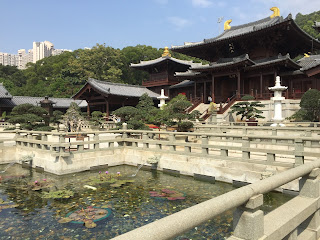
Hall of Celestial Kings and Sakyamuni Buddha Hall, Chi Lin Nunnery
This is a working temple, so there are rules and restrictions, but Buddhists tend to be pretty forgiving. Unless you eat in front of one of the Buddha statues. They don't like that.

Lotus Pond Garden, Chi Lin Nunnery
Chi Lin and Nan Lian are a small bridge apart. The garden also has rules, mostly about not feeding the fish. They don't even want you to have a snack near the pond, which is understandable. I'm sure people feed the fish all kinds of poisonous crap.

Blue Pond, Nan Lian Garden
The Pavilion of Absolute Perfection has kind of an arrogant name, and is too gold for my tastes, but it looks nice in the middle of all that green.

Pavilion of Absolute Perfection, Nan Lian Garden

Lotus Pond, Nan Lian Garden
I think this might be the first video I have ever taken with this camera. Taking pictures with a phone is strange enough. Taking video phone videos is too science fiction for me.
Chinese Timber Architecture Gallery, Nan Lian Garden
Kwun Tong is close to the cruise terminal and a few quick stops from Diamond Hill. It is also an authentically Hong Kong neighborhood. When I took this picture, a few people stared at me and then stared at the street below the walkway, probably wondering what on earth I was looking at.

Kwun Tong, near Tung Yan St
We went back to Hung Hom for dinner. Food is everywhere in Hong Kong, but the Whampoa shopping area is ridiculous. If you ate at a different restaurant for every meal, it would take years to make your way through it all.

Taku St, near Hung Hom Pancakes
Above all the restaurants and shopping malls are thousands of apartments, instead of the usual office buildings and more shopping. The shopping malls are mostly underground.

Bulkeley St at Taku St
Some apartments are nicer than others.
Hung Hom Rd at Tak On St
We had dinner near one of the last phone booths in the city. There are probably others somewhere, but I can't think of any. Why would anyone use a phone booth in this day and age? For the Wi-Fi, of course.

Man Tai St, near a Wellcome
Lily and I had some free time on Saturday. She thought it would be a good idea to go to some of the parks I don't get out to very often. When you take your daily walks in the same place all the time, it gets tedious. Hong Kong has more than enough parks to keep it interesting. Most of them require spending time on the MTR.
We went to the Hung Hom Promenade in the morning. That is a neighborhood I rarely go to, and the small promenade has nice views of Kowloon Bay and the East Harbour rather than the usual Wan Chai and Tsim Sha Tsui. There is some construction around one of the hotels right now, blocking a few paths to get to the promenade, but the promenade itself is unscathed.

You can easily see the new cruise terminal at the old airport from the promenade. Something I discovered about my phone is that the pictures look terrible when you zoom.

We took the MTR from Whampoa to Lok Fu, which is six or seven stops. The green light shows where we are, between the second and third stop. The red lights show where the train goes. The white lights show the interchange to the Tsuen Wan line and the fastest way to get from Whampoa to Central. It's all very simple and informative. I don't know why people think it is confusing.
A great thing about the Kwun Tong line is that it's not nearly as crowded as some of the others. There would be a dozen heads in this picture if it were the Tsuen Wan, Tung Chung, West, East or Island lines.

It's an easy walk from the Lok Fu station to the Kowloon Walled City Park, which does not look like this anymore.

From exit A, turn right and make a left on Junction Road. That is where the street ends, so you can't miss it. Walk down Junction Road for a few minutes until you see a playground. Either keep going until you see the entrance on the left or turn left at the playground, Tung Tau Tsuen Road, to one of the entrances on the right.
The signs in the station tell you to take exit B to go to the Walled City Park. If you follow those signs, you will go to the bus stop, which is fine if you want to take the bus. Walking out of the station from the bus stop is complicated if you don't know the area. Exit A is signed and simple.

The Walled City mostly looks like this now, which I think is a vast improvement.

Two stops from Lok Fu is Diamond Hill. Right next to the station is the Nan Lian Garden and Chi Lin Nunnery. Both are open to the public, free and beautiful places to pretend you are not surrounded by a city of 7 million people.


This is a working temple, so there are rules and restrictions, but Buddhists tend to be pretty forgiving. Unless you eat in front of one of the Buddha statues. They don't like that.

Chi Lin and Nan Lian are a small bridge apart. The garden also has rules, mostly about not feeding the fish. They don't even want you to have a snack near the pond, which is understandable. I'm sure people feed the fish all kinds of poisonous crap.

The Pavilion of Absolute Perfection has kind of an arrogant name, and is too gold for my tastes, but it looks nice in the middle of all that green.


I think this might be the first video I have ever taken with this camera. Taking pictures with a phone is strange enough. Taking video phone videos is too science fiction for me.
Kwun Tong is close to the cruise terminal and a few quick stops from Diamond Hill. It is also an authentically Hong Kong neighborhood. When I took this picture, a few people stared at me and then stared at the street below the walkway, probably wondering what on earth I was looking at.

We went back to Hung Hom for dinner. Food is everywhere in Hong Kong, but the Whampoa shopping area is ridiculous. If you ate at a different restaurant for every meal, it would take years to make your way through it all.

Above all the restaurants and shopping malls are thousands of apartments, instead of the usual office buildings and more shopping. The shopping malls are mostly underground.

Some apartments are nicer than others.

We had dinner near one of the last phone booths in the city. There are probably others somewhere, but I can't think of any. Why would anyone use a phone booth in this day and age? For the Wi-Fi, of course.

Wednesday, August 23, 2017
Sunday, August 20, 2017
Taipei On a Train
Not that long ago, getting from the airport into the city required either several connections or one long bus or taxi ride. Like a lot of large Asian cities, the airport is nowhere near the city.
Taoyuan International Airport recently underwent some major renovations. Most of it looks cosmetic, as far as I can tell, but one big difference is that now you can take a train directly from the airport into the city. When they built the high speed train line, it never touched the airport, for some reason. To get from one to the other, you had to take a slow and not especially clean shuttle bus. They filled up pretty fast, and waiting for the second or third bus in the rain was never pleasant. There was always the regular bus that went from the airport into the city, but that was always slow and not especially clean.
Some time between my last trip and this one, they connected the airport to the high speed train. That means you can take a single train, with no shuttles, into the city. Since the high speed train system is only about ten years old, I don't see why they did not do this right from the beginning. There is probably a convoluted political answer.
Ironically, there was a smaller airport right across the river from our hotel. Unfortunately, there are no direct flights from Hong Kong.
Once you are in the city, Taipei's MRT system is pretty much like Hong Kong's MTR or Tokyo Metro. Taipei has fewer lines in a smaller space, making it pretty simple to navigate. Hong Kong and Tokyo always made it easy to get into the city from the airport.
Something I have always wanted to do is take a train across the United States. Right now, I don't have the time, and I don't live conveniently close. I would also like to take a bullet train across Japan. That takes less time. Those trains are fast, and Japan is considerably smaller. As it turns out, a Japanese company made the high speed trains that run the length of Taiwan. Taiwan was also nice enough to make itself much smaller than Japan or the United States. The length of Taiwan is about the same distance as New York to Washington, DC. You can take the high speed train from one end of the country to the other in less than two hours.
From Taipei, the other end is Kaohsiung. I don't know anything about Kaohsiung, but a few people have told me I should go there. It has the largest natural harbor in the country, apparently. And lots of shopping. When you live in Hong Kong, people always tell you about other cities with shopping. I don't get it. That is almost like living in Chicago and people telling you about pizza in Indiana.
Lily and I took the high speed train from Taipei to Kaohsiung. Not to go to Kaohsiung, and certainly not to go shopping. We wanted to ride the train. The cars have wide windows, so you get a good view of the scenery. Unfortunately, we did not get much scenery. Taipei had blaring sunlight. Taichung, in the middle of the country, was cloudy and had obviously rained before we got there. South of Taichung, we sped headlong into a storm. The scenery for half the trip was dark and wet.
The end of the line was Kaohsiung, which has its own MRT system to get from the station to more interesting parts of the city. But it was raining heavily and we knew nothing about Kaohsiung. I'm all for exploring new places, but we could do that in Taipei without a cloud in the sky. After lunch at the shopping mall connected to the station, we went back. This time, we left the gloom and rode into the light.
Taoyuan International Airport recently underwent some major renovations. Most of it looks cosmetic, as far as I can tell, but one big difference is that now you can take a train directly from the airport into the city. When they built the high speed train line, it never touched the airport, for some reason. To get from one to the other, you had to take a slow and not especially clean shuttle bus. They filled up pretty fast, and waiting for the second or third bus in the rain was never pleasant. There was always the regular bus that went from the airport into the city, but that was always slow and not especially clean.
Some time between my last trip and this one, they connected the airport to the high speed train. That means you can take a single train, with no shuttles, into the city. Since the high speed train system is only about ten years old, I don't see why they did not do this right from the beginning. There is probably a convoluted political answer.
Ironically, there was a smaller airport right across the river from our hotel. Unfortunately, there are no direct flights from Hong Kong.
Once you are in the city, Taipei's MRT system is pretty much like Hong Kong's MTR or Tokyo Metro. Taipei has fewer lines in a smaller space, making it pretty simple to navigate. Hong Kong and Tokyo always made it easy to get into the city from the airport.
Something I have always wanted to do is take a train across the United States. Right now, I don't have the time, and I don't live conveniently close. I would also like to take a bullet train across Japan. That takes less time. Those trains are fast, and Japan is considerably smaller. As it turns out, a Japanese company made the high speed trains that run the length of Taiwan. Taiwan was also nice enough to make itself much smaller than Japan or the United States. The length of Taiwan is about the same distance as New York to Washington, DC. You can take the high speed train from one end of the country to the other in less than two hours.
From Taipei, the other end is Kaohsiung. I don't know anything about Kaohsiung, but a few people have told me I should go there. It has the largest natural harbor in the country, apparently. And lots of shopping. When you live in Hong Kong, people always tell you about other cities with shopping. I don't get it. That is almost like living in Chicago and people telling you about pizza in Indiana.
Lily and I took the high speed train from Taipei to Kaohsiung. Not to go to Kaohsiung, and certainly not to go shopping. We wanted to ride the train. The cars have wide windows, so you get a good view of the scenery. Unfortunately, we did not get much scenery. Taipei had blaring sunlight. Taichung, in the middle of the country, was cloudy and had obviously rained before we got there. South of Taichung, we sped headlong into a storm. The scenery for half the trip was dark and wet.
The end of the line was Kaohsiung, which has its own MRT system to get from the station to more interesting parts of the city. But it was raining heavily and we knew nothing about Kaohsiung. I'm all for exploring new places, but we could do that in Taipei without a cloud in the sky. After lunch at the shopping mall connected to the station, we went back. This time, we left the gloom and rode into the light.
Saturday, July 1, 2017
Hailey's Novel Diary – 7/1/17
Here's something I never knew. As a public service, I will share it with the world.
According to some taxi website, a taxi ride from Chatsworth to the Van Nuys Courthouse is $62.97, and another ride to the impound lot is $10.51. With tips, that's about $80. That sounds high to me.
According to the city of Los Angeles, the standard rate for an impounded car is $124, plus $39 for daily storage, $7 mileage rate, $115 release fee and a 10% city parking tax. If your car is impounded, you have to pay the city for the privilege of parking in their impound lot. That comes to $313.50.
Did you know any of that? I sure did not. Now we all do.
Did you ever care? Neither did I. They say we learn something new every day, but they never said it would be useful information.
According to some taxi website, a taxi ride from Chatsworth to the Van Nuys Courthouse is $62.97, and another ride to the impound lot is $10.51. With tips, that's about $80. That sounds high to me.
According to the city of Los Angeles, the standard rate for an impounded car is $124, plus $39 for daily storage, $7 mileage rate, $115 release fee and a 10% city parking tax. If your car is impounded, you have to pay the city for the privilege of parking in their impound lot. That comes to $313.50.
Did you know any of that? I sure did not. Now we all do.
Did you ever care? Neither did I. They say we learn something new every day, but they never said it would be useful information.
Tuesday, May 26, 2015
Paris Diary part 10
Day 12
20°, sunny.
Lily & I spent most of the day near the Seine before going up to Montmartre later on. We worked at night, so we had most of the day off to explore.
The highlight of the day was riding scooters around the short and winding roads of Montmartre and driving a 1960s Citroën DS. Lily & I both have limited experience with driving scooters in Hong Kong, but I have driven more in Mainland China.
The Citroën DS was something else altogether. It looks different on the outside and feels different on the inside. The steering wheel was attached to the column at a central point just like any other car, but rather than have several spokes that branch out like most cars, this only had one arm connected to the wheel. It felt strange and looked like the steering wheel was floating in air.
But the most unusual thing about this car, in my opinion, was that the gear stick was mounted on the steering column. This may have been common practice at the time, but I have always driven cars with gear sticks between the seats. When coming to a stop, my right arm automatically reaches down, even when I drive an automatic. It took a while to get used to reaching up when I wanted to shift gears.
The difference between driving in France and driving in China is like the difference between eating a handmade chocolate truffle from a maître pâtissier and eating a lump of dog shit off the ground. Pardon my French.
I don't idolize France or French people. They have their own share of problems. But when it comes to following the rules of the road and common courtesy, the French are a million miles above the Chinese.

20°, sunny.
Lily & I spent most of the day near the Seine before going up to Montmartre later on. We worked at night, so we had most of the day off to explore.
The highlight of the day was riding scooters around the short and winding roads of Montmartre and driving a 1960s Citroën DS. Lily & I both have limited experience with driving scooters in Hong Kong, but I have driven more in Mainland China.
The Citroën DS was something else altogether. It looks different on the outside and feels different on the inside. The steering wheel was attached to the column at a central point just like any other car, but rather than have several spokes that branch out like most cars, this only had one arm connected to the wheel. It felt strange and looked like the steering wheel was floating in air.
But the most unusual thing about this car, in my opinion, was that the gear stick was mounted on the steering column. This may have been common practice at the time, but I have always driven cars with gear sticks between the seats. When coming to a stop, my right arm automatically reaches down, even when I drive an automatic. It took a while to get used to reaching up when I wanted to shift gears.
The difference between driving in France and driving in China is like the difference between eating a handmade chocolate truffle from a maître pâtissier and eating a lump of dog shit off the ground. Pardon my French.
I don't idolize France or French people. They have their own share of problems. But when it comes to following the rules of the road and common courtesy, the French are a million miles above the Chinese.

Monday, May 27, 2013
My First Train Crash
On Friday, May 17, just after 16:00, an MTR light rail train crashed. It was the worst derailment in MTR history – 77 people were injured, including a baby. Fortunately, no one was killed. Unfortunately, I was on that train.
I had a rare Friday off from work, so I wanted to go out to the New Territories and look around. I don't get out there as much as I would like. There is far more to Hong Kong than the giant skyscrapers. Most of the city is nature and scenery, but you have to get out of the city to find it.
While I was minding my own business on a small train on a small line between Hang Mei Tsuen and Tong Fong Tsuen, it felt like the train was moving too fast. It's above ground, so you can see everything go by. It's hard to judge speeds on the underground trains because you can't see anything except black tunnels. On this train, we could tell that it was going too fast. I wasn't the only passenger who thought so. In some cities, no one would notice. New York, for example, is not a city known for its smooth subway rides. Hong Kong, on the other hand, has an impressive safety record. Until now.
The train made a turn and all hell broke loose. The front car slowed down for the turn, apparently not enough. The back car didn't slow down at all, knocking half of itself and all of the front car off the tracks. Anyone who was unaware that something was amiss quickly learned otherwise. Even the sleeping passengers could hear the noise. Metal crashed into metal. People screamed. Glass shattered. Before this, I would have thought the abrupt deceleration was the most striking aspect. It was the noise.
Most of the train bid farewell to the tracks and greeted a power line. It didn't flip over or explode or do anything as exaggerated as a movie. It was more like a car impact. Everybody fell to the ground or up against the windows. More than half of the passengers were injured. Most of the injuries were minor. I broke a few bones in my right hand when I tried not to fall down. You're supposed to go limp when you fall to avoid injuries. I bet the people who give that advice never spend much time in train crashes.
Fortunately, it was a smaller train in the New Territories, where there is little traffic. Being above ground was also an exceptionally good thing. Everyone simply walked or crawled or was carried out of the train, paying special attention to downed power lines. If it had derailed in a tunnel, getting everyone out would have been much more difficult.
Everyone just sat near the train and waited. I don't know if people were in shock, but it was more calm than I would have expected. Then the firefighters and paramedics arrived and it got loud and hectic again. It didn't take long for the news cameras and onlookers to show up. Pretty soon, there were at least ten times more responders and observers than there were passengers on the train. I saw more firefighter uniforms than passengers.
A few paramedics asked me if I was injured. They didn't speak much English and my Chinese does not include emergency medical terms. It was obvious the way I was holding my hand that something was wrong. When one of the paramedics grabbed at it, I let out a scream that pretty much told them all they needed to know. They put me in an ambulance after all of the unconscious and bleeding passengers were gone. The doctors at the hospital all spoke English, so it got easier once I was there.
When the doctor showed me the x-rays of my hand, I was just happy it wasn't my foot. I like having hands and I use them all the time, but I need my feet for my career. If it was a foot instead of my hand, my dancing days would probably be over.
My hand is currently better than it was, but I'm still mostly typing this with my left hand. Since it's gotten better than it was, the doctors assume it will get better than it is. I'm thankful to be in a place that has excellent healthcare at bargain basement prices. Hong Kong has well trained doctors and nurses, and my insurance pays for practically everything.
The government is going to fine the MTR HK$15 million. Now they're talking about a big lawsuit against the MTR. I don't know any details, but I'm sure if it happens, the passengers won't see any money.
I don't want their money anyway. I just want them to figure out what happened, fix it and make sure it never happens again.
I had a rare Friday off from work, so I wanted to go out to the New Territories and look around. I don't get out there as much as I would like. There is far more to Hong Kong than the giant skyscrapers. Most of the city is nature and scenery, but you have to get out of the city to find it.
While I was minding my own business on a small train on a small line between Hang Mei Tsuen and Tong Fong Tsuen, it felt like the train was moving too fast. It's above ground, so you can see everything go by. It's hard to judge speeds on the underground trains because you can't see anything except black tunnels. On this train, we could tell that it was going too fast. I wasn't the only passenger who thought so. In some cities, no one would notice. New York, for example, is not a city known for its smooth subway rides. Hong Kong, on the other hand, has an impressive safety record. Until now.
The train made a turn and all hell broke loose. The front car slowed down for the turn, apparently not enough. The back car didn't slow down at all, knocking half of itself and all of the front car off the tracks. Anyone who was unaware that something was amiss quickly learned otherwise. Even the sleeping passengers could hear the noise. Metal crashed into metal. People screamed. Glass shattered. Before this, I would have thought the abrupt deceleration was the most striking aspect. It was the noise.
Most of the train bid farewell to the tracks and greeted a power line. It didn't flip over or explode or do anything as exaggerated as a movie. It was more like a car impact. Everybody fell to the ground or up against the windows. More than half of the passengers were injured. Most of the injuries were minor. I broke a few bones in my right hand when I tried not to fall down. You're supposed to go limp when you fall to avoid injuries. I bet the people who give that advice never spend much time in train crashes.
Fortunately, it was a smaller train in the New Territories, where there is little traffic. Being above ground was also an exceptionally good thing. Everyone simply walked or crawled or was carried out of the train, paying special attention to downed power lines. If it had derailed in a tunnel, getting everyone out would have been much more difficult.
Everyone just sat near the train and waited. I don't know if people were in shock, but it was more calm than I would have expected. Then the firefighters and paramedics arrived and it got loud and hectic again. It didn't take long for the news cameras and onlookers to show up. Pretty soon, there were at least ten times more responders and observers than there were passengers on the train. I saw more firefighter uniforms than passengers.
A few paramedics asked me if I was injured. They didn't speak much English and my Chinese does not include emergency medical terms. It was obvious the way I was holding my hand that something was wrong. When one of the paramedics grabbed at it, I let out a scream that pretty much told them all they needed to know. They put me in an ambulance after all of the unconscious and bleeding passengers were gone. The doctors at the hospital all spoke English, so it got easier once I was there.
When the doctor showed me the x-rays of my hand, I was just happy it wasn't my foot. I like having hands and I use them all the time, but I need my feet for my career. If it was a foot instead of my hand, my dancing days would probably be over.
My hand is currently better than it was, but I'm still mostly typing this with my left hand. Since it's gotten better than it was, the doctors assume it will get better than it is. I'm thankful to be in a place that has excellent healthcare at bargain basement prices. Hong Kong has well trained doctors and nurses, and my insurance pays for practically everything.
The government is going to fine the MTR HK$15 million. Now they're talking about a big lawsuit against the MTR. I don't know any details, but I'm sure if it happens, the passengers won't see any money.
I don't want their money anyway. I just want them to figure out what happened, fix it and make sure it never happens again.
Subscribe to:
Posts (Atom)